
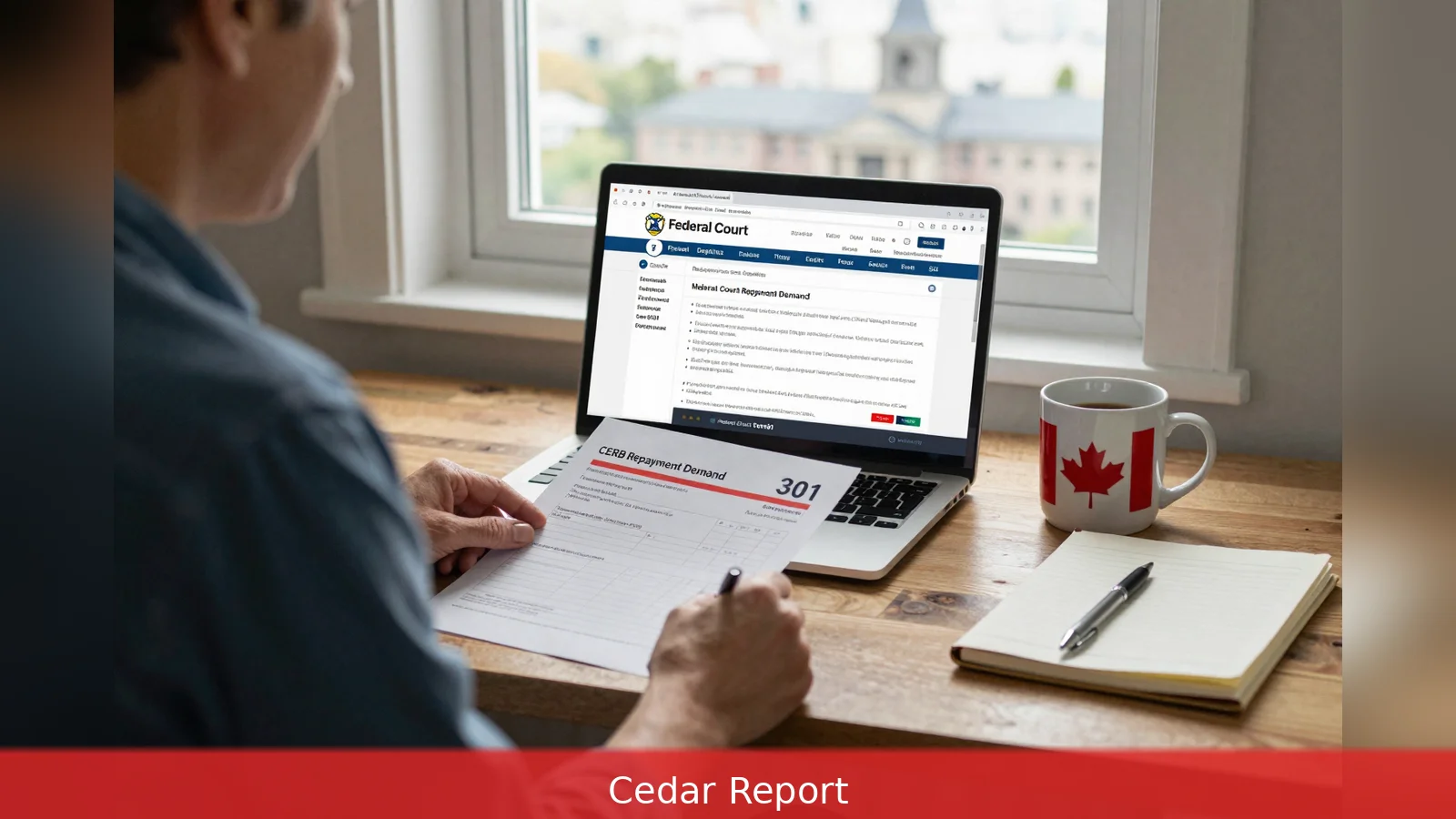
30 days. That's the statutory window to ask a court to review most federal decisions, including Canada Revenue Agency CERB assessments or repayment demands. The Federal Court framework requires a completed Form 301, strict service rules, and adherence to Part 5 of the Federal Courts Rules, Rules 300 to 319, or you risk losing the right to bring the application without first winning an extension. Start by confirming who issued the decision, obtain and complete Form 301, and contact the Federal Court registry to confirm the filing address, the number of copies the Crown needs, and the current fee.
30 days. Count from the date you received the decision, not from when it was issued. That single figure governs most judicial-review windows for Canada Revenue Agency matters such as CERB assessments or repayment demands. If you miss that deadline, the court will generally require a separate motion for an extension of time before it will consider your application.
1. Confirm who made the decision and when you received it
The first factual task is straightforward: identify the decision-maker, the date of the decision, and the date you were first told of it. The Notice of Application you will file must state the name of the tribunal or decision-maker, the decision date and details, and the date on which the decision was first communicated to you. Check the decision document for that communication date because the 30-day clock normally begins on that date.
Worked example: if the CRA sent a letter dated May 2 and your mail shows you received it on May 7, the counting date is May 7 and your filing deadline will be 30 days after that date. If the decision instead came from a board or tribunal that directs review to another court, you will need to follow that forum guidance.
2. Decide the correct court and follow the right path
Who issued the decision determines the forum. The Canada Revenue Agency directs applicants to file with the Federal Court using Form 301. By contrast, some federal boards point applicants to the Federal Court of Appeal. For example, the Canada Industrial Relations Board states its decisions go to the Federal Court of Appeal rather than the Federal Court.
Worked example: a CERB repayment demand administered by the CRA follows the Federal Court path. A decision issued by the Canada Industrial Relations Board follows the Federal Court of Appeal path. Confirm the issuer before you file to avoid filing in the wrong court.
3. Pursue the administrative remedy the agency recommends
The CRA advises seeking a second administrative review before launching a court application. The Federal Court and practitioner guides make the same point: administrative review is frequently required or at least advisable because courts usually assess whether an agency decision was reasonable and whether the process was fair. Courts rarely substitute their own view of the facts; a successful judicial review most often results in the matter being returned to the agency for reconsideration by another official.
Worked example: if the CRA letter suggests asking for a second review or reconsideration, do that first and keep the correspondence. The court will want to know you followed any available internal remedy and this step can shape what grounds you put forward in a Notice of Application.
4. Prepare Form 301, the Notice of Application, and supporting evidence
The Federal Court provides Form 301 as the official template for an Application for Judicial Review. The Notice of Application must include the parties' names, the tribunal name, the decision details and communication date, a description of the relief sought, the grounds of review including the statutory or rule provisions relied on, a list of affidavits and documents supporting the application, and a list of documents you have asked the tribunal to produce if they're not already in your possession.
Worked example: your Notice should list the CRA as the respondent, specify the exact date and file number of the CERB assessment or demand, state that you seek an order quashing the decision and sending it back for reconsideration, and attach affidavits or documents that show when you received the decision and any internal review correspondence.
5. File the Notice and pay the fee with the Federal Court registry
The CRA page instructs that a completed Form 301, with the appropriate filing fee, be sent to the registrar of the Federal Court. The Federal Court's registry offices can provide filing addresses and confirm the current fee. Self-represented litigants can contact the registry for procedural assistance; the Federal Court also maintains a Self-Represented Litigants section with contacts across Canada.

Worked example: before you mail or deliver Form 301, call or email the registry to confirm the correct physical or electronic filing address, whether they still accept paper or require electronic submission, and what the current filing fee is. That avoids wasted trips or returned filings.
6. Serve the Notice properly and file proof of service
A Notice of Application is an originating document and must be served in accordance with the Federal Courts Rules. The Federal Court requires that originating Notices be served on respondents and that proof of service be filed with the Registry. The Registry can arrange service on the Attorney General of Canada; confirm with the Registry how many copies you must provide and the filing deadlines.
Worked example: after filing, arrange service on the CRA respondent promptly. Deliver the copies the Registry requires so they can serve the Attorney General on your behalf. Then file an affidavit or certificate of service within the time required by the Rules to document that the respondents were served.
7. Follow Part 5 of the Federal Courts Rules and pick realistic grounds
Applications for judicial review are governed by Rules 300 to 319 in Part 5 of the Federal Courts Rules. The Federal Court also points out that other statutes can set different limitation periods, either longer or shorter than 30 days, so if a different statutory limitation applies you must follow that statute. If more than 30 days have passed since the decision was communicated, you must bring a separate motion for an extension of time to commence the proceeding.
Worked example: consult Rules 300 to 319 for the format and timing obligations and confirm whether any specific statute tied to your matter creates a different deadline. Frame your grounds knowing the court's standard of review: the court will normally accept the tribunal's factual findings and consider whether the tribunal's reasons were rational and intelligible. If the court finds a minister's discretion was not properly exercised, the usual outcome is referral back to the CRA for reconsideration, not substitution of the court's own decision.
Practical cautions and ancillary duties
The Federal Court warns that proceedings can be complicated and recommends legal advice for self-represented litigants. You remain responsible for meeting all timing, service, and document requirements under the Federal Courts Rules. If you need documents in the tribunal's possession you don't have, identify them in the Notice and ask the tribunal to produce them. The Canada Industrial Relations Board points applicants to the Federal Court of Appeal registry where relevant, and Steps to Justice reiterates that judicial review asks whether the CRA's decision was reasonable and that lawyers or community legal clinics can help set realistic objectives.
Worked example: if you can't find a key internal memo that the CRA relied on, list that document in your Notice and request production. If the decision came from a body that refers review to the Federal Court of Appeal, contact that registry for its process and service rules.
How courts usually resolve CRA judicial review applications
Expect the court to ask whether the decision was reasonable and whether the process was fair. The CIRB explanation of judicial review practice notes that an appellate court will normally accept the facts as found by the tribunal and decide whether the tribunal's decision was reasonable, looking at whether the tribunal's reasons were rational and intelligible. The CRA explains that if it's determined the Minister's discretion was not properly exercised, the Federal Court can't change the CRA's decision but can refer the decision back to the CRA for reconsideration by another delegated official.
Worked example: if your application argues the CRA failed to consider important evidence, the court will review the record to see whether the CRA's reasoning was intelligible. If the court finds the reasoning inadequate, it will usually order reconsideration rather than issue the relief you asked for directly.
When the 30-day clock isn't the whole story
The 30-day rule is the primary filing deadline cited for CRA matters, but it's not absolute. The Federal Court page warns that other statutes can create different limitation periods. If you discover a different statutory limitation applies, you must follow that statute. If more than 30 days have passed, you must bring a separate motion for an extension of time.
Worked example: if an enabling statute for a particular tribunal sets a shorter deadline, that shorter period controls. Conversely, if an applicable statute provides a longer period, follow the longer timeline instead of the 30-day default.
Checklist before you file
First, confirm the decision-maker and the date you received the decision. Second, pursue any recommended administrative review with the CRA. Third, complete Form 301 following the Federal Court's template and list all supporting affidavits and documents. Fourth, contact the Federal Court registry to confirm filing address, the required number of copies for the Crown, and the current filing fee. Fifth, arrange service and file proof of service according to the Rules. Sixth, check Rules 300 to 319 for timing and document requirements and identify any statute that sets a different limitation period.
In Short:
- 30 days from receipt is the usual window for CRA CERB judicial review.
- Use Form 301 and follow Part 5, Rules 300 to 319, of the Federal Courts Rules.
- Contact the Federal Court registry to confirm address, copies for the Crown, and the current filing fee before you submit.
Related Articles
- Direct deposit for Canada Child Benefit: 6 ways to sign up
- Apply for social assistance in Montreal: 4 steps to qualify
- Choose a Python job queue: 7-step trade-off guide
Obtain and complete Form 301, then contact the Federal Court registry to confirm the filing address, how many copies the Registry needs to serve the Attorney General, and the current filing fee before you submit your Notice of Application.
This article was created with AI assistance.


