
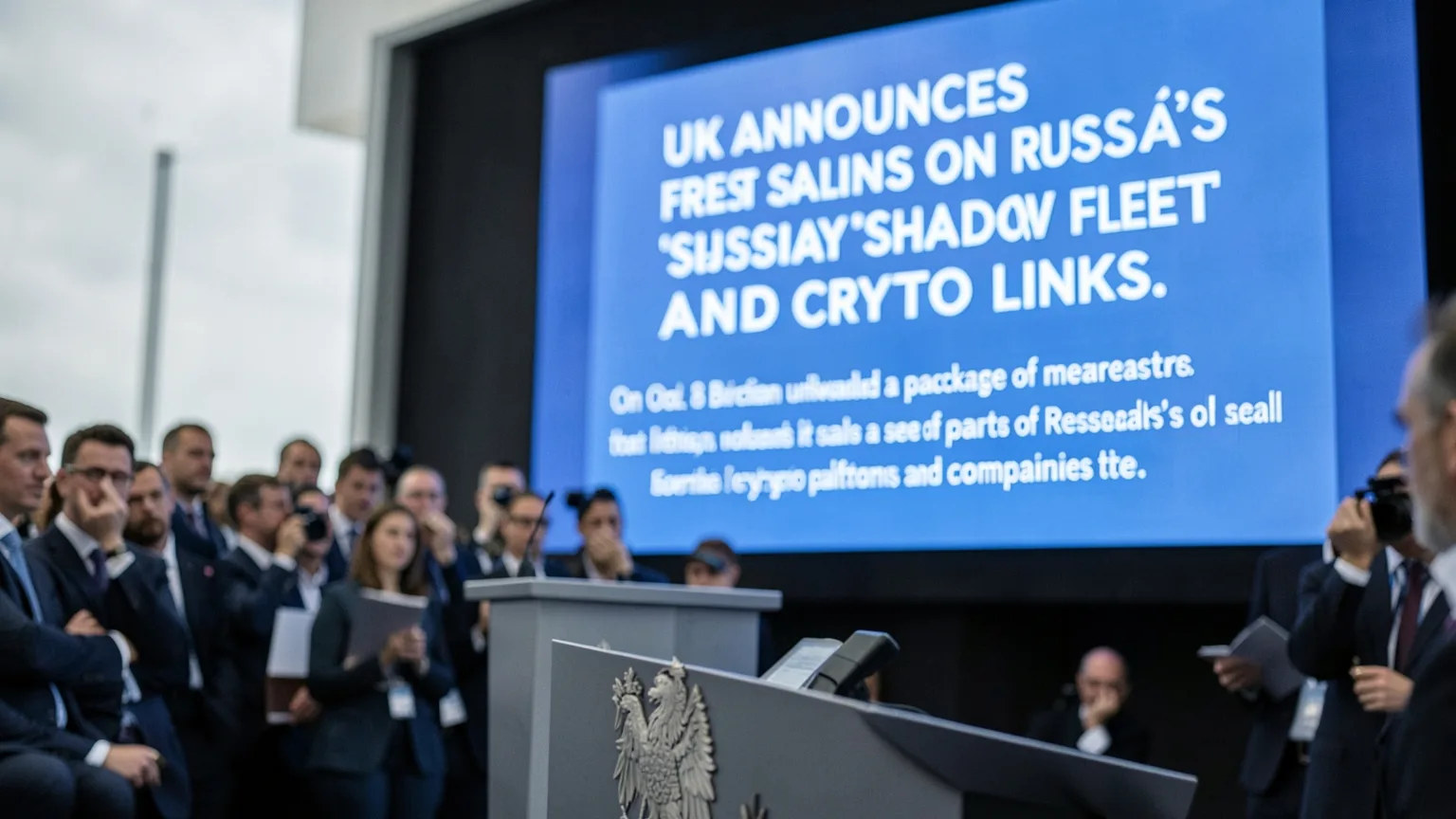
On Oct. 8 Britain unveiled a package of measures that it says adds dozens of listings, including a set of vessels it calls part of Russia’s “shadow fleet,” several crypto platforms and companies tied to military supply chains.
What the UK announced
Reuters reported Britain’s Oct. 8 package is pitched as a move to choke Russia’s ability to sell and move energy and to disrupt channels used to hide or shift funds linked to the war effort, by adding vessels, crypto and payment platforms and companies to the U.K. sanctions list [uk.finance.yahoo.com].
Reuters says the package includes 12 oil tankers, three crypto exchanges and two payment platforms alongside other entities and individuals identified as involved in oil transport, military supply or efforts to circumvent financial restrictions [uk.finance.yahoo.com].
The Kyiv Independent reports the U.K. published 38 new sanctions listings and added 12 ships to what it calls Russia’s “shadow fleet,” bringing the U.K. total of sanctioned vessels to 645 and the overall number of U.K. Russia sanctions to 3,537 [kyivindependent.com].
A list attributed to the British government published by UA.NEWS names specific firms included in the package, citing Russian banks such as Stolichny Kredit and JSC Planeta, energy firms JSC Zarubezhneft and JSC INK-Capital, 12 shadow-fleet vessels and a set of foreign companies from Canada, Kyrgyzstan, Turkey, India and Thailand [ua.news].
Separately, on Oct. 5 the U.K. announced a package that targeted LNG tankers and bunkering vessels and said those ships would face U.K. shipping and trade restrictions intended to limit revenues flowing to Moscow [www.engine.online].
Reuters reports the U.K. also said two newly listed entities had processed and facilitated transactions with what Britain calls the A7 illicit finance network, which the government describes as central to sanctions evasion [uk.finance.yahoo.com].

The Kyiv Independent carried a quotation from a U.K. sanctions listing saying Xeltox Enterprises “has been involved in obtaining a benefit from or supporting the government of Russia by carrying on business in a sector of strategic significance (...) the financial services sector” [kyivindependent.com].
What the measures mean for Russia and affected businesses
Reuters says the U.K. frames these listings as tools to make it harder and more expensive for Moscow to sell and move energy cargoes and to close routes by which sanctioned funds might be shifted, singling out vessels it calls part of a “shadow fleet” as well as crypto and payments platforms Britain says are being used to evade restrictions [uk.finance.yahoo.com].
“Shadow fleet” is used by the U.K. and outlets including the Kyiv Independent and Engine to mean older, repurposed or poorly maintained ships accused of evading rules and helping Russia skirt price caps and bans on oil and gas trade; bringing such vessels onto the U.K. list subjects them to U.K. shipping and trade restrictions, the government says [kyivindependent.com].
The government says listing on the U.K. sanctions register creates concrete legal restrictions: frozen U.K. assets, bans on UK persons dealing with listed entities and limits on the use of U.K. financial and logistical services. Those steps, Britain says, raise the cost and risk of helping Russia export energy or move money linked to the war [kyivindependent.com].
Listing is a legal designation, not proof of criminality; the reporting attributes claims about who facilitated transactions or belonged to the A7 network to the U.K. announcements themselves rather than treating them as independently established fact [uk.finance.yahoo.com].
Practically, the measures are meant to restrict services vessels and firms rely on (insurance, port calls, fuel and spare parts) and to cut off access to regulated financial plumbing when transactions touch U.K. jurisdiction or involve U.K. persons, according to the reporting [uk.finance.yahoo.com].
Canada’s angle
UA.NEWS reports the U.K. listings include “foreign companies from Canada” among other countries, saying those firms were accused of providing economic support to the Russian government or supplying goods and technology [ua.news].
None of the reporting cited above carries an independent statement from the Canadian government confirming Canadian measures or naming specific Canadian firms on a Canadian sanctions list; the pieces attribute listings and allegations to the U.K. announcements rather than to Canadian policy statements [uk.finance.yahoo.com].
If Canadian businesses do appear on a U.K. sanctions list, the immediate practical consequence reported here is that those firms would face the legal limits that follow from being designated under U.K. law for transactions touching U.K. jurisdiction or services; the reports do not offer legal or financial advice nor say Canada has changed its own domestic sanctions rules [ua.news].
On Oct. 8 Britain announced a fresh sanctions package it says targets parts of Russia’s oil transport network, crypto and payment platforms and suppliers to its defence industry; reporting gives slightly different tallies (Reuters lists 12 tankers, three exchanges and two payment platforms along with entities and individuals, while other outlets report as many as 38 new listings and name specific firms and banks) and all accounts attribute claims about facilitation or evasion to the U.K. announcements rather than presenting those points as independently proved [uk.finance.yahoo.com].
This article was created with AI assistance.


