
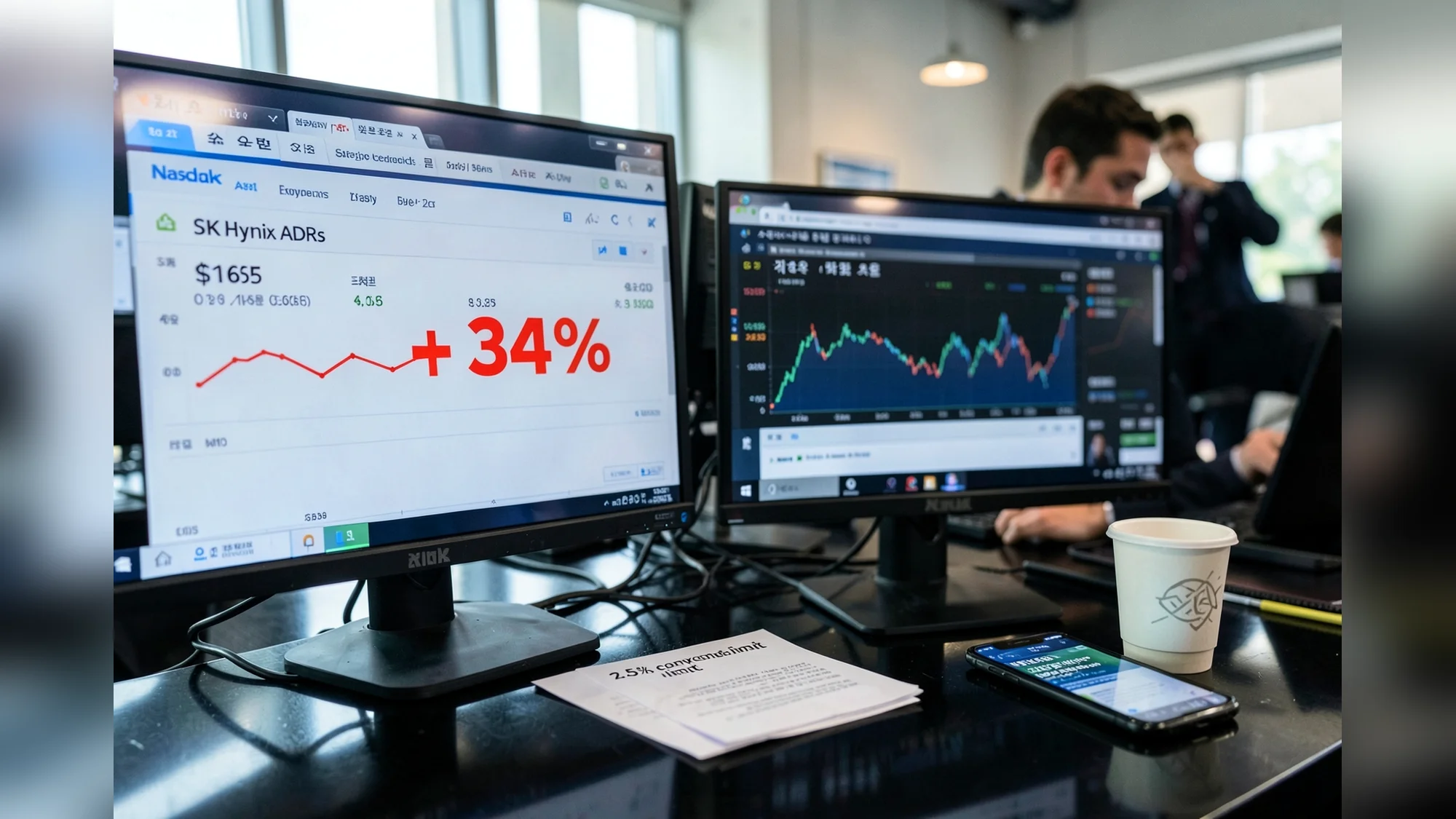
2.5% is the limit on how many SK Hynix ordinary shares can be converted into American Depositary Receipts, a restriction that market participants say will keep U.S. ADRs trading well above onshore shares. ADRs were trading more than 34% above Korean-listed ordinary shares, with prices at $165.27 on Nasdaq after Wednesday and premarket quotes near $176 on Thursday, MarketWatch reported. The Korea Securities Depository said the 2.5% figure is the issuer-set ceiling and clarified that a 25% number in an SEC filing was only a custody estimate for fee calculation. The pause on ADR issuance and cancellation through July 29 means the immediate supply channel that might close the gap is temporarily shut.
34%. That was the gap between SK Hynix ADRs and the company’s Korean ordinary shares after the U.S. close, according to MarketWatch, with ADRs at $165.27 on Nasdaq and premarket quotes near $176 on Thursday. That spread matters because cross-listed convertibility is normally the mechanism global asset managers and arbitrage desks use to equalize prices across markets.
The Korea Securities Depository, through its president Lee Yoon-soo on July 22, said the 25% figure cited in an SEC filing was a custody estimate used to calculate fees, not a domestic conversion ceiling. Lee said the actual conversion limit set by SK Hynix is 2.5%, and that expanding that limit would be a decision for the issuer rather than the KSD. He also noted that converting ADRs back into domestic shares is unlikely while the ADR premium stays large, since ADR holders have little incentive to convert into the cheaper onshore stock.
That legal and operational makeup narrows the practical arbitrage window. Trading platforms and automated reporting flagged a halt to ADR issuance and cancellation until July 29 while onshore registration of new ordinary shares is processed.
Several trade and fund-level participants have concluded the capped convertibility, together with the pause, reduces the ability of traders to create or cancel ADRs to exploit the price gap.
Technically, the restriction limits near-term ADR supply that could otherwise be created by converting domestic shares into receipts. Market participants say that supply constraint, when combined with concentrated option flows and short-term volatility across semiconductor names, has supported elevated ADR implied volatility and reinforced the premium.
Analysts point to precedents such as Taiwan Semiconductor Manufacturing, where the proportion of ADRs grew only through issuer-side steps such as additional board approvals and regulator filings rather than automatic conversions. Those comparisons suggest the premium could persist until structural action is taken by SK Hynix or by regulators, or until price moves close the gap organically.
The KSD clarification on July 22 and the temporary freeze on issuance mean the immediate mechanism for new ADR creation is limited. Absent an issuer-led offering, a change to the issuer-set limit, or a wave of conversions by ADR holders despite the price gap, the current premium is likely to remain in place through the pause.
Related Articles
- Micron still trades cheap after 325% rally
- 3.2 trillion rotation leaves S&P effectively stalled
- AI capex could hit $1.1T by 2027, Goldman warns
The pause on ADR issuance and cancellation is scheduled to continue through July 29, when registration conditions on the Korean side are due to be resolved. Originally reported by marketwatch.com.
This article was created with AI assistance.