
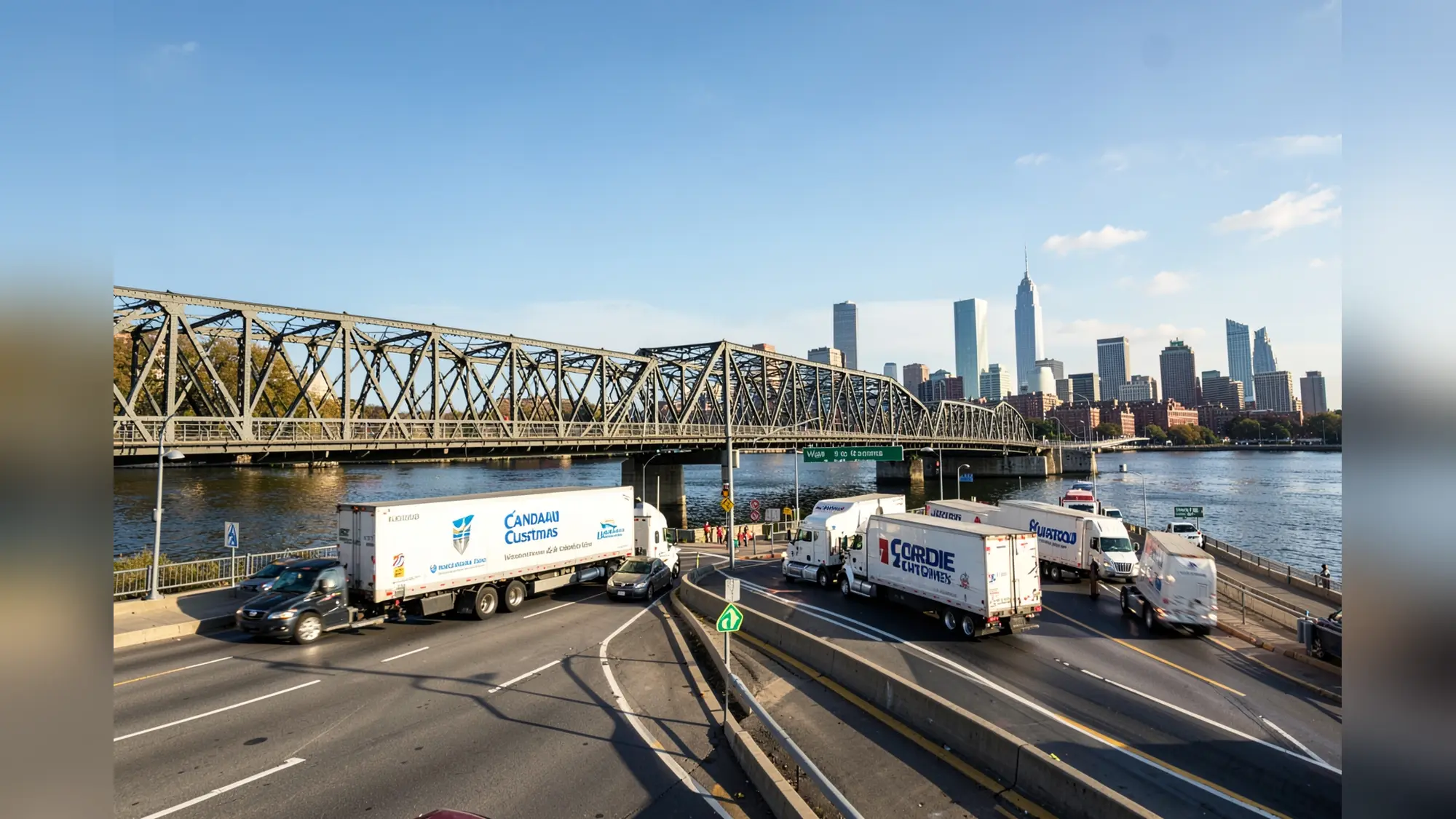
850,000 hours. That's how much truck drivers are expected to save each year in wait time once the Gordie Howe International Bridge opens. Those time savings, combined with lower tolls and three lanes of commercial traffic each way, are projected to cut operating costs for trucking firms and speed shipments across a corridor that moves about $1 billion in goods daily, according to Invest WindsorEssex and industry estimates cited by Canadian authorities. The figures matter because they translate minutes per trip into material monthly savings for fleets and faster flows for auto parts that cross the border multiple times during assembly.
How the numbers add up
44.5 percent. A filing from the U.S. Department of Homeland Security estimated the Gordie Howe route would capture 44.5 percent of the corridor's commercial traffic. That share is the load-bearing fact behind the time and cost projections, because shifting nearly half the trucks off existing crossings concentrates the benefit where congestion is worst.
The bridge's design supports the estimate. Three lanes of commercial traffic each way, and a direct connection between U.S. Highway 75-series routes and Ontario's 400-series highways, shorten approaches and reduce idling. Per-trip savings may be only a few minutes, but across daily flows those minutes aggregate to the roughly 850,000 hours per year figure that Invest WindsorEssex and industry estimates use.
Businesses with just-in-time cross-border supply chains stand to gain most, especially trucking companies and automakers. Invest WindsorEssex calculates about $1 billion in U.S.-Canada trade moves through the Windsor-Detroit corridor every day, so faster crossings affect a large volume of goods and inventories.
The Canadian Trucking Alliance estimates that the new crossing will reduce firms' costs by between $20,000 and $100,000 per month depending on fleet size. Those savings reflect reduced driver time, lower fuel use from less idling, and slightly lower tolls on the Gordie Howe route compared with existing private crossings.

Larger fleets sit at the high end of the range because aggregate minutes saved scale with vehicle counts.
Concordia University economist Moshe Lander captured the scale in plain terms, calling the bridge "a tremendous opportunity here in dollar terms," and pointing to gains that go beyond the handful of minutes per trip. For auto manufacturing, where parts can cross the border several times in production, reduced border friction cuts scheduling risk and the inventory buffers that tie up capital.
Local impacts and operational realities
Traffic won't simply vanish from downtown Windsor. The corridor currently relies on the Ambassador Bridge, the Blue Water Bridge and the Detroit-Windsor Tunnel, and major congestion at customs plazas and local approaches has pushed wait times higher in recent years. Redistributing nearly half of commercial trucks to the new crossing should reduce pressure on those downtown approaches and on local streets that were once forced to handle heavy truck flows.
Delivering the headline time savings depends on customs staffing and port processing. The DHS designation and related filings set the legal and operational baseline for the new port of entry, but regulators and border agencies must align procedures and staffing to realise the full reductions in wait time. The bridge's expected lower tolls and the negotiated revenue sharing play a role too, because slightly cheaper crossings nudge private traffic patterns toward the new route.
The bridge's construction cost became part of the political negotiation. Federal and media accounts reported a $4.7 billion construction price tag.
That price informed talks over tolling and revenue sharing, which produced a 15-year side agreement to govern how revenue will be split so the crossing could open. Political friction delayed some ceremonial plans, prompting Canadian officials to cancel a planned joint U.S.-Canada ribbon-cutting and instead plan a Canadian-only event, even as officials confirmed the opening schedule.
Related Articles
- 49,000 Chinese EVs cleared for Canada, tariff set
- Iran broadcasts Revolutionary Guard seizure of two ships in the Strait of Hormuz
- Hormuz Closure Turns Strait Into Oil‑Trade Legal Flashpoint
The next concrete test arrives July 27, 2026, when the bridge is scheduled to open to traffic and initial commercial crossings will put the new port-of-entry procedures, negotiated tolls and revenue-sharing arrangements to work. Originally reported by cbc.ca.
This article was created with AI assistance.


