
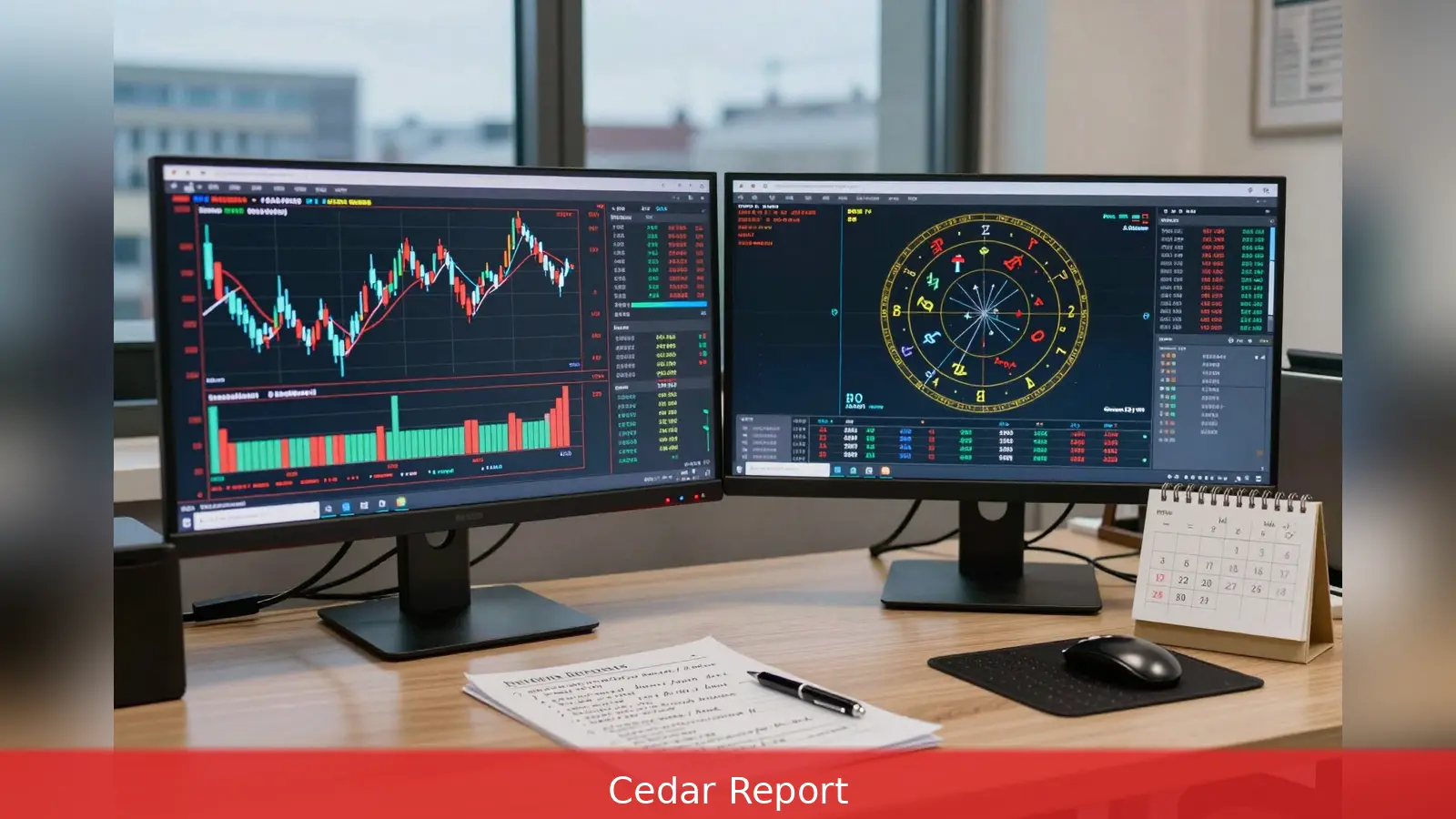
15,075+ first-trade charts are cited in commercial financial-astrology products such as AstroApp, a scale that shapes how traders choose the watchlist universe when they add planetary timing to a trading process. This guide lays out a disciplined, repeatable ten-step sequence traders can follow to build a watchlist that sits on top of existing technical and fundamental rules. It organises vendor features, practitioner methods, and course content into concrete actions: define your universe, pick a small set of astrological primitives, convert them into machine rules, backtest, and fold results into execution and risk limits. By treating astro signals as timing overlays rather than price predictions, the method keeps standard risk controls in place while testing whether cycles add edge.
15,075+ first-trade charts, 18,300+ company records, and roughly 25 years of historical price and ETF data form the core datasets advertised by one provider's Financial Edition and they set expectations about what coverage you can realistically scan.
1. Define the watchlist universe and data sources
Start with a concrete, reproducible universe that your chosen tools can cover. Commercial platforms advertise tens of thousands of first-trade and incorporation charts and multi-market price histories; verify that the provider covers the exchanges, ETFs, and cryptocurrencies you plan to trade. One platform, for example, lists company coverage across 12 countries and 15 markets, claims more than 25 years of historical stock and ETF data for core markets, and advertises 575 supported cryptocurrencies plus end-of-day FOREX rates.
Decide whether you will trade large-cap stocks, an ETF-and-index list, a basket of momentum small caps, or a crypto-only group. The dataset you select determines the scale of the watchlist and the statistical power of any backtests. If the vendor includes more than 4,000 ETF first-trade charts and 440+ cryptocurrency first-trade charts, use those counts to choose the right universe size rather than assuming universal coverage.
2. Choose astrological primitives and methodology
Pick a small set of astrological elements to use as timing signals and record precise definitions for each. Options appearing in vendor and course material include Planetary aspects and transits, First-trade horoscopes, Incorporation charts, planetary cycle overlays (geocentric, heliocentric, topocentric), moon-sign or lunation filters, and W. D. Gann style planetary support and resistance lines. Practitioner instructors cited in course listings, including Art of Trading, teach a mix of classical and regional techniques such as Gann methods, Vedic/KP approaches, Nakshatra based filters, and event-driven date selection.
If you use regional methods such as Nakshatra or KP, document timezone, coordinate, and calculation conventions so signals are reproducible. Practitioners emphasise that astro tools act as a lens on crowd psychology and timing, not as a stand alone price prediction system.
3. Translate signals into machine readable rules
Convert qualitative astrological statements into deterministic rules your platform can scan. Use precise time windows, explicit aspect orb widths, and exact event definitions so the filter produces the same candidate list on repeated runs.
Commercial products list tools that allow Boolean combinations, astro indicators, and event period filters, and some offer pre built rule libraries such as 22 rule trading systems.
Keep each rule single purpose and testable. For example, a rule might read: "Flag stock when (lunar node within 1 degree of stock's first trade ascendant) and (daily ATR above 14 period SMA)". Save the exact timestamp conventions and coordinate inputs with the rule so you can reproduce results later.
4. Combine astro filters with technical and fundamental screens
Do not let astrology be the sole selector. Rajeev Prakash's trading guide frames financial astrology as a timing overlay rather than a price prediction tool and recommends using planetary timing on trades you already want to take. Pair your astro windows with objective technical screens such as trend regime, volume confirmation, momentum thresholds, or earnings and corporate event exclusions.
Record tradeable setups as conjunctions of an astro timing window plus at least one non astro trigger. This layered approach reduces false positives and keeps trade signals actionable. For example, require both a defined lunar aspect and a breakout above a 50 period moving average with volume above a 30 day average.
5. Sample and rank candidates into a watchlist
Decide whether your watchlist will be binary, ranked by an astro technical score, or structured into tiers such as "high alert" and "monitor." Some platforms enable composite planetary cycles and statistical profitability analysis that produce sortable scores. Define how many names you will monitor intraday and how many you will keep on a rolling positional list.

For intraday and swing strategies, shorter astro windows such as lunar aspects are common. For positional allocation, longer planetary cycles and nodal returns are useful candidate filters. Make the ranking rules explicit, for instance by assigning 60 percent of the score to technical criteria and 40 percent to astro timing intensity.
6. Backtest event performance and compute statistics
Use historical event period analysis to measure how price behaved around the astro events you plan to use. Commercial tools describe event charting, event period profitability analysis, and statistical correlation reports. Backtests should include hold period, slippage assumptions, transaction costs, and out of sample testing where possible.
Treat outcomes as evaluative data, not proof. Rajeev Prakash warns that financial astrology lacks mainstream academic validation and statistical results require careful interpretation. Keep records of every parameter set you test so you can reproduce forward runs and avoid post hoc rationalisations.
7. Design execution and risk management rules
Convert watchlist alerts into execution rules that include position sizing, stop placement, trade duration limits tied to the astro window, maximum open positions, and rules for conflicting astro signals. Course descriptions emphasise money management modules and event based trading that set explicit rules for exits and exposure.
If your strategy relies on short intraday windows or red letter trading days, build automated alerts or calendar reminders linked to the exact event timestamps. Define how to resolve conflicting signals, for example by always deferring to the non astro technical trigger when a planetary cycle and a short term lunar signal disagree.
8. Validate the live workflow and monitoring cadence
Confirm that the provider supplies the required market feeds and update cadence for your strategy. One vendor advertises live intraday and close of day price and volume streams for multiple markets plus the ability to combine technical indicators with astro events in charts. Decide whether you will monitor intraday alerts, conduct a daily pre market check, or perform a weekly positional review.
Use a "top red letter day" concept if you want a monthly focal point. Some practitioners publish a single most significant astro day per month for concentrated monitoring. Decide the number of names you will actively follow on those days to limit cognitive load and execution risk.
9. Invest in structured education and operate transparently
Document the refund and access terms if you acquire a course or paid tool. Training offerings in the sample material promise modules on fundamentals, planetary methods, case studies, backtesting, and live coaching. Some course listings state cancellation and refund policies and note administrative processing times; record these terms and any vendor promises you rely on during testing.
Keep copies of terms and screenshots of any vendor claims you rely on during testing. If you subscribe to live coaching or a platform, treat the administrative window as a trial period to evaluate whether the pedagogy, data coverage, and feed cadence match your workflow.
10. Maintain a research log and periodic review schedule
Track every filter change, the outcome of backtests, forward performance by calendar period, and false positive rates. Reassess astro primitives and technical pairings on a fixed cadence, for example quarterly, and require statistical significance before expanding the watchlist or increasing allocation. Treat astro indicators as hypotheses to be tested, not as immutable rules.
Keep a change log that records who altered a rule, when they did it, and why. That discipline turns subjective judgements into testable interventions and prevents creeping exposure driven by anecdotes rather than numbers.
Practical implementation notes
Commercial products offer advanced search with Boolean criteria, the ability to analyse portfolio charts for commonalities, 15 astro indicators combined with 93 technical indicators, and tools to build trading strategies from groups of astro events. Practitioner guides advise the mindset that astro timing is a filter on crowd psychology and that traders shouldn't abandon price structure, liquidity, or standard risk controls.
Course syllabi in the material include intraday dashboards tied to KP and Vedic cycles, Gann pressure dates, momentum stock identification using Nakshatra sheets, and live coaching calls for practical application. Use those modules to learn the calculation conventions each method requires before you automate scans.
In short
1. Start small: pick a reproducible universe your provider covers and document coverage counts such as ETFs and crypto.
2. Choose a few astro primitives, define them precisely, and record timezone and coordinate conventions.
3. Convert signals into deterministic, testable rules and always pair them with at least one non astro technical or fundamental trigger.
4. Backtest with realistic costs, keep a research log, and respect the vendor's stated refund and access terms if you trial paid courses or tools.
Related Articles
- Direct deposit for Canada Child Benefit: 6 ways to sign up
- 9 Steps to Improve Personal Loan Approval Odds
- Crypto fraud prevention: 8 steps after $94M in losses
If you trial a paid course or platform, act within the vendor's stated refund and access terms; administrative processing times vary, so treat the refund deadline as the immediate decision point while you test the workflow.
This article was created with AI assistance.


