
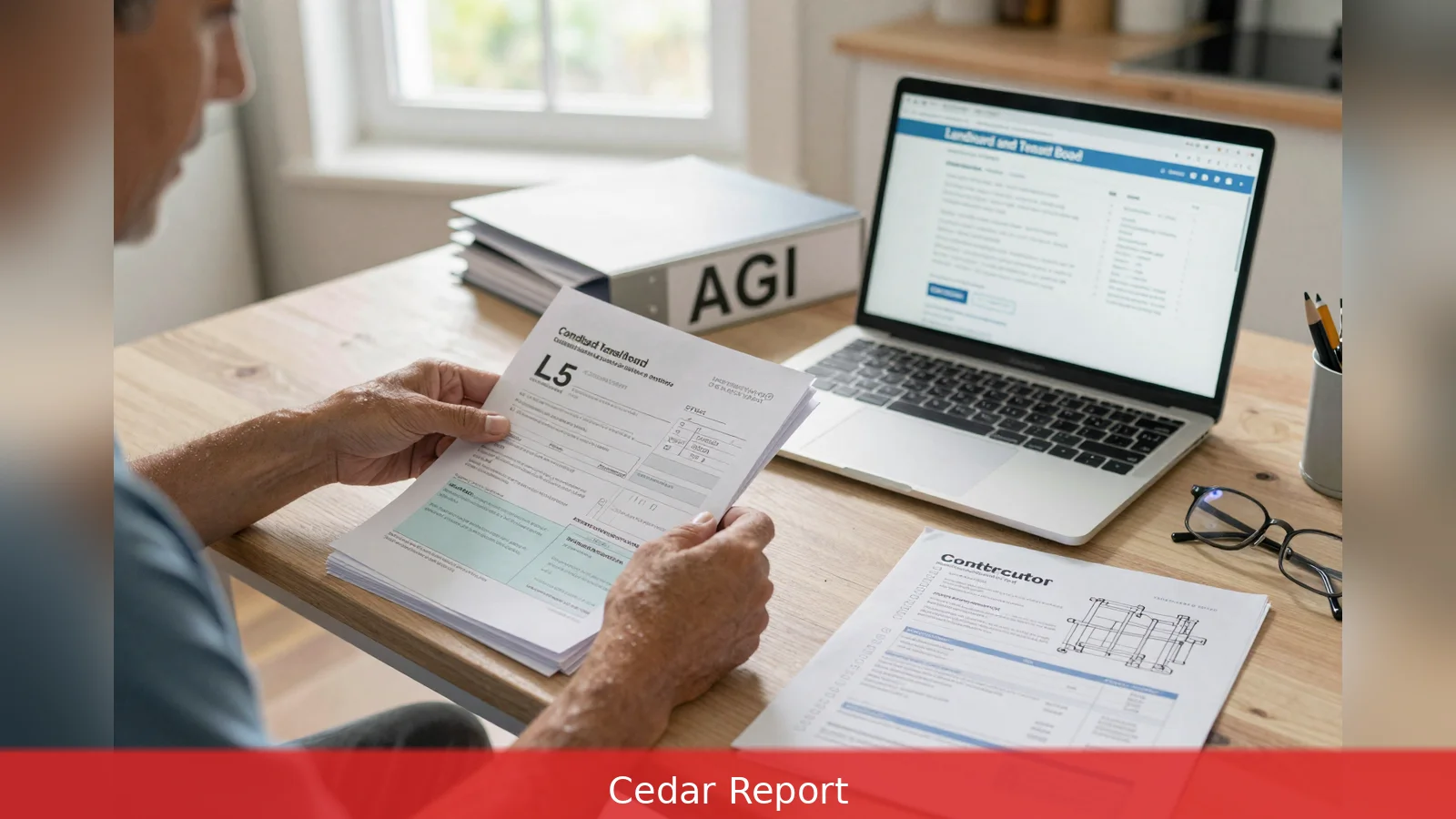
If you want to raise rent above Ontario's annual guideline, file an L5, Application for an Above Guideline Increase, with the Landlord and Tenant Board. A landlord sits at a kitchen table with a stack of paid invoices and the L5, deciding which receipts to attach and which units to include. The L5 is the formal route under the Residential Tenancies Act when an Ontario landlord seeks permission for an above-guideline increase. The law limits AGIs to three reasons: extraordinary municipal tax increases, eligible capital expenditures, or new or increased security-service costs. You must still respect timing rules, including waiting at least 12 months between increases and giving at least 90 days written notice.
At an LTB hearing table the focus is on discrete documents: invoices, engineering reports and the dates work started and finished. The Landlord and Tenant Board expects evidence that maps precisely to the statutory tests in the Residential Tenancies Act and its related regulations, so every receipt, contract and project timeline matters.
1. Check whether the guideline and timing rules apply
First, confirm whether the regular rent increase guideline actually limits the unit you want to change. Units first occupied for residential use on or before November 15, 2018 are usually subject to the guideline. Units first occupied after that date are usually exempt, but exemption doesn't remove the procedural rules tied to increases. That means even exempt units are still subject to the timing and notice requirements that govern rent changes.
Second, respect the timing rules. At least 12 months must have passed since the last rent increase or since the tenancy began. And the tenant must receive at least 90 days written notice. Using the wrong notice form or giving not enough notice can render an increase invalid, so treat the form and the notice period as part of the legal test, not mere paperwork.
Worked example: a landlord who raised rent in January 2024 can't lawfully start a new increase before January 2025, and must still serve at least 90 days written notice even if seeking Board approval. The LTB provides the required forms and instructions on its website, so use those exact documents when you serve notice.
2. Identify the statutory ground that fits your situation
The Residential Tenancies Act allows an above-guideline increase only for one of three statutory reasons.
Know which category applies before you file the L5.
First, an AGI can be sought for an extraordinary increase in municipal taxes and charges for the residential complex. Not every municipal line item counts.
The Act and LTB materials specify which municipal charges are included and which are excluded. Penalties, interest, emergency municipal repairs and costs that amount to a capital expenditure by the municipality are typically excluded from the municipal-tax calculation.
Second, an AGI can be based on eligible capital expenditures. A capital expenditure means an extraordinary or significant renovation, repair, replacement or addition with an expected benefit that extends for at least five years. Importantly, units whose tenancy began after a capital project was completed can't be included in an AGI that relies on that expenditure. That exclusion often surprises landlords who assume a building-level upgrade can be applied to all current tenants.
Third, an AGI can be based on new or increased operating costs for security services. The claim must show either that security services are being provided for the first time by persons not employed by the landlord, or that existing security costs have increased.
Worked example: if you added a building-wide security guard contract in 2023, and the contract was not in place before, that cost may form the statutory basis for an AGI. If instead you just increased pay to existing on-staff doormen, the Board will assess whether that change fits the statutory definition for security-service increases.

3. Measure the claimed expense to meet the statutory tests
Third, measure and document the expense in a way that satisfies the legal definitions. For municipal taxes, the Act and the LTB materials set a narrow calculation. The increase must be "extraordinary" to qualify. That's defined as any municipal tax increase that exceeds the guideline plus 50 percent of the guideline. For example, if the applicable guideline for the year is 2.2 percent, 50 percent of that's 1.1 percent, and any municipal tax increase greater than 3.3 percent would be treated as extraordinary for AGI purposes.
For capital expenditures you will need to show three things in particular: the work was significant, the expected useful life meets the five-year test, and the costs are properly documented as capital rather than routine maintenance. Separate the invoices into capital and operating buckets. Preserve contractor contracts, start and completion dates, and any engineering or contractor reports that describe the nature of the work and its expected lifespan.
Worked example: replacing an aging roof with materials that extend the roof life by 20 years is typically a capital expenditure. Repeated patching of leaks is more likely routine maintenance. The Board will look at the substance of the work and how you accounted for it, not just how you labelled the expense in your internal books.
4. Prepare the L5 package and decide which units to include
Fourth, prepare the L5, Application for an Above Guideline Increase carefully and assemble your evidence. An AGI application may seek an increase for just some of the rental units in a residential complex or for all units. The filing should include the L5 form plus supporting evidence such as paid invoices, contracts, engineering or contractor reports and accounting schedules that separate capital costs from operating costs.
Interpretation guidance from the Landlord and Tenant Board explains that, except in specified limited circumstances, the Board must issue an order for an AGI when a landlord meets the statutory requirements. The Board publishes Interpretation Guidelines to promote consistency in decisions, but a member hearing the case isn't bound to follow the guidelines if the facts justify a different outcome. That means your package should make the statutory case plainly and leave no gaps the Board member must infer.
Worked example: if you rely on a capital expenditure, include the contractor agreement showing start and finish dates, the paid invoices, an engineering report that explains the expected useful life, and an accounting schedule that allocates the total cost across the units you propose to include. If a unit was first occupied after the work was finished, exclude it or explain why it can't be included under the statutory rules.
5. Understand the limits on recovery and practical implementation
Fifth, know the practical cap on recovery. When an AGI is granted based on eligible capital expenditures or security services, the typical practical cap is the guideline plus up to 3 percent, and the Board may allow that additional recovery to be phased in over time. The exact amount recoverable depends on the statutory calculation and the Board order, but the general expectation is that recoveries are limited and may be staggered rather than applied as a single large jump.
Also note an important procedural limit: the LTB doesn't have discretion to consider a tenant's personal financial circumstances when deciding whether to grant an AGI. The Board focuses on whether the legal tests and evidentiary standards are met, not on tenant affordability. That places the emphasis squarely on documentary proof of the expense and the statutory fit, rather than on sympathetic arguments about hardship.
Worked example: if the Board accepts that eligible capital costs justify an AGI and calculates the allowable increase at guideline plus 2.5 percent, it may order that the landlord put in place the increase in phased steps, for instance 1 percent in the first year and 1.5 percent in the second, depending on the wording of the order.
6. Expect an evidentiary hearing and know the Board's ground rules
Sixth, prepare for a hearing. The landlord must prove the statutory elements of the chosen AGI ground. For capital expenditures that means showing the nature of the work, why it was extraordinary or significant, the expected multi-year benefit and that the costs were capital in character. For municipal-tax claims that means demonstrating the charge is properly classified as a municipal tax or charge and that the increase meets the extraordinary threshold. Still for security-service claims the landlord must show the costs are for security services provided by persons not employed by the landlord for the first time, or that the costs increased.
The Board's materials instruct members on how to interpret the law and the regulations, including references to RTA section 126 and to O. Reg. 516/06 provisions that govern eligible capital expenditures and exclusions. Because the Board's analysis is tightly legal and document-driven, present a clear trail from each invoice or report to the statutory element it supports.
Worked example: bring a one-page chronology that lists each project, its start and end date, the contractor, the invoice total, and the line in the regulation or guideline the invoice supports. That chronology helps the hearing member see the link between your documents and the statutory test.
7. Technical and practical points frequently overlooked
Seventh, attend to technical details that can invalidate an otherwise meritorious AGI. Tenants who began their tenancy after a capital project was finished are excluded from AGIs based on that work. A landlord seeking recovery should separate invoices and accounting entries into capital and operating buckets and preserve contractor contracts and start and completion dates. The Board's guidance and the Residential Tenancies Act focus on statutory compliance rather than assessing the necessity or quality of every renovation. Where evidence shows the statutory tests are met, the Board's guidance indicates members will typically grant an AGI.
Also remember the notice form itself signals the legal track the landlord is pursuing. Using the wrong form or failing to include required particulars can be a fatal technical error. The Landlord and Tenant Board provides guidance and forms on its website for landlords and tenants to follow; use them.
Worked example: a landlord who bundles operating repairs with a capital claim without segregating costs risks having the Board treat some or all of the expenditures as routine maintenance and deny that portion of the AGI. Clear accounting and complete contractor files reduce that risk.
In short, the path to a successful AGI is documentary. The Board won't guess at project dates, useful life, or the classification of a charge. Provide the contracts, paid invoices, engineering or contractor reports and accounting schedules the Board needs to see.
Next steps for landlords who intend to move forward are procedural: complete the L5 form, assemble the supporting evidence as described above, and file the application with the Landlord and Tenant Board. For tenants who receive notice, review the L5 and the supporting documents closely and consider whether any procedural defect in notice or timing may invalidate the application.
Related Articles
- 5 steps to get a Calgary Public Library card
- Why Java developers fail coding interviews and how to fix it
- GST/HST credit up 2.7%: who qualifies and how to get it
Complete and file the L5 with the supporting invoices, contracts and reports using the Landlord and Tenant Board forms, and double-check that your notice and timing meet the statutory rules before you proceed.
This article was created with AI assistance.


