
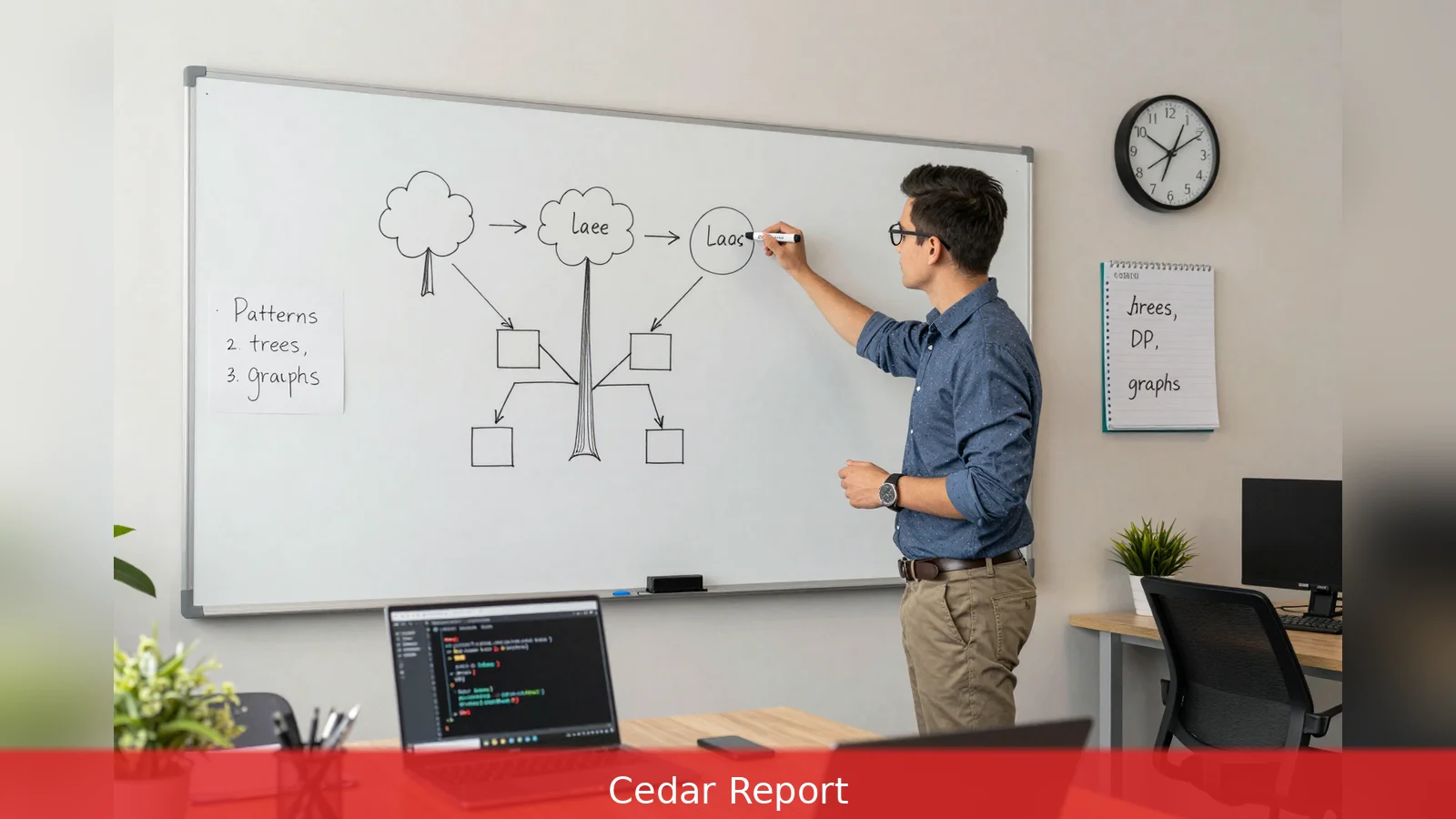
Why do experienced Java developers who ship production code every day fail simple interview problems? Multiple practitioner accounts point to one answer: interviews test fundamentals and habits that differ from day-to-day Java work, and candidates often fail the format and preparation rather than the language. Pass4Sure flags weak data structures and algorithms knowledge, while Intervue notes that candidates often struggle with whiteboard and timed-platform conditions. The remedy is practical and procedural: rebuild fundamentals, practise the interview loop, simulate interview constraints and rehearse clear narration and incremental delivery.
How can someone comfortable with Spring, streams and dependency injection flounder on a tree traversal or an array two-sum question?
1. Rebuild the fundamentals, explicitly and repeatedly
First, accept that interview problems emphasise data structures and algorithmic patterns over framework or API knowledge. Pass4Sure lists inadequate understanding of basic structures as the top reason candidates fail. Linked-list manipulations, tree algorithms, heaps, graph traversals and tries appear again and again, as do algorithmic paradigms such as divide-and-conquer, greedy algorithms, dynamic programming and backtracking. Experienced engineers who rely on libraries and high-level frameworks can lose fluency in those core topics, and interviewers expect not only working code but a demonstration of best approaches and trade-offs.
Second, make the review active. Passive reading of theory won't rebuild fluency. Work through canonical problems for each structure, and practise writing the code by hand or in a stripped editor. For each problem, state the time and space complexity and compare alternatives. A short worked example: take tree traversals. First, put in place a recursive in-order traversal on paper, then sketch an iterative version using an explicit stack, and finally discuss where each approach trades memory for simplicity. Repeating that pattern across lists, heaps and graphs forces pattern recognition, which is the interviewer's currency.
2. Make the interview problem loop procedural
First, adopt a repeatable sequence for every problem you practise. Both Pass4Sure and byby.dev point to the same strategic errors: candidates dive into code without restating the problem, they skip clarifying questions, and they omit edge cases. A disciplined loop stops those errors. It runs like this: read and restate the prompt, ask or state assumptions, propose a brute-force idea, propose and justify an optimized plan, outline edge cases, write pseudocode, implement, and test with examples.
Worked scenario: you are handed a problem that asks for the kth smallest element in an unsorted array. Restate the input shape and constraints: is k always valid, are duplicates allowed, what are expected input sizes? Propose a brute-force sort then index approach, explain its O(n log n) cost, and then propose using a heap or Quickselect for better average complexity. Sketch pseudocode for Quickselect, put in place a simple partition-based version, and run a hand example that includes duplicates and k at the bounds. Practising the loop until it's procedural prevents the scatter that kills an interview.
3. Simulate constraints and the tools interviewers use
First, remove the training wheels. Intervue argues that whiteboard interviews and live coding sessions put candidates in environments without an editor, compiler or test harness, and that mismatch often drives failure. Intervue highlights whiteboard-style work and live-coding platforms as part of that problem; practise with those environments and with whiteboard-like restrictions.
Second, timebox your practice to mirror real interview durations. Run full problems under an enforced time limit, disable IDE conveniences, and practise typing and structuring code in a plain text area. If the role uses a coding platform, run through the same kinds of platform problems so the submission and runner behaviour is familiar. That removes anxiety from the toolchain and leaves you to focus on problem solving.
4. Train thinking-out-loud and concise explanation
First, treat your narration as part of the solution. Pass4Sure and byby.dev both identify poor communication of thought process as a recurring cause of rejection. Interviewers are evaluating your reasoning path as much as your final code. If you skip verbalising assumptions or fail to explain trade-offs, the interviewer can't credit your approach.
Second, practise explicit explanation. Record a mock session with a peer or a phone recorder and listen back. Explain why you choose a particular data structure, how you identify and handle corner cases, and what trade-offs you accept between clarity and performance. A short example: when asked to design a cache, say aloud why a hash map plus a doubly linked list implements LRU efficiently, state the cost of operations, then outline concurrency caveats. Clear, concise narration converts private intuition into visible skill.

5. Work on time allocation and incremental correctness
First, break problems into implementable chunks. Byby.dev highlights that developers used to long development cycles often misallocate interview time. In a timed setting you can lose the chance to deliver anything correct if you aim for the best, but complex, approach from the start. Instead, aim for progressive delivery: put in place a correct but slower version first, then iterate toward the best solution.
Second, practise chunked delivery explicitly. For example, when solving a graph shortest-path problem, first put in place a simple breadth-first search to produce a working baseline for unweighted edges, then evolve to Dijkstra or A-star if weights are present. That yields a partially correct implementation the interviewer can evaluate, and it demonstrates pragmatic risk management under time pressure.
6. For senior candidates, reframe the interview narrative
First, recognise the senior trap. Byby.dev documents senior-specific patterns: overconfidence, assumptions that experience substitutes for practice, and a tendency to expect interviews to credit architectural experience rather than algorithmic fluency. Interview rubrics often stay focused on algorithmic and coding tasks even for senior roles.
Second, prepare dual tracks. Recondition for timed problem solving and refresh core algorithms. In parallel, prepare concise behavioural and system-design narratives that show design judgment, trade-off analysis and leadership. Rehearse short, specific stories about trade-offs you made in production systems, then tie each story to a clear technical lesson. Treat interviews as a skill that requires deliberate practice, not as an automatic reward for seniority.
7. If you hire or mentor, align tasks to job reality
First, recognise that interview design matters. Intervue argues interviews are often poorly matched to the role and recommends more realistic assessment design. Hiring managers can prefer role-relevant assignments and realistic take-home or paired-programming tasks over abstract whiteboard puzzles. That benefits both sides: it measures what matters on the job and rewards practical engineering skills.
Second, candidates can anticipate mismatch and ask hiring teams for clarity. Before a loop begins, ask what each stage is designed to evaluate so your preparation and your opening statements match the interviewers' goals. If a role emphasises system design, note that explicitly in your pre-interview conversation and allocate your time accordingly.
Putting the steps together: a weekly practice plan
First, pick a coding platform commonly used by employers and commit to a measurable plan. The synthesis of practitioner accounts converges on a simple weekly rhythm: two to three timed sessions on a commonly used coding platform, one whiteboard-style practise with a peer, and one focused fundamentals review session that targets a pattern category such as trees or dynamic programming.
Second, make the sessions intentional. In each timed platform session, follow the interview problem loop: restate, clarify, outline brute-force and optimized approaches, and narrate while coding. In whiteboard practice, ban the IDE and force hand-drawn pseudocode and proofs of complexity. Track progress by logging problems by pattern category and noting whether you completed the loop fully, whether you narrated your choices, and how you allocated time.
In short
- Rebuild core data structures and algorithm patterns through active problem solving.
- Turn the interview problem loop into habit: restate, clarify, plan, pseudocode, implement, test.
- Simulate real constraints: whiteboard practice and platform sessions.
- Practise thinking-out-loud and delivering incremental correctness.
- Senior candidates should refresh fundamentals and rehearse concise system-design and behavioural narratives.
Related Articles
- GST/HST credit up 2.7%: who qualifies and how to get it
- Automate vendor contract comparison and negotiation in 7 steps
- Apply for CERB judicial review in Federal Court, 30-day limit
Pick one coding platform, run timed sessions that replicate whiteboard or live-coding constraints, and log progress against pattern categories such as trees, dynamic programming and graphs.
This article was created with AI assistance.


