
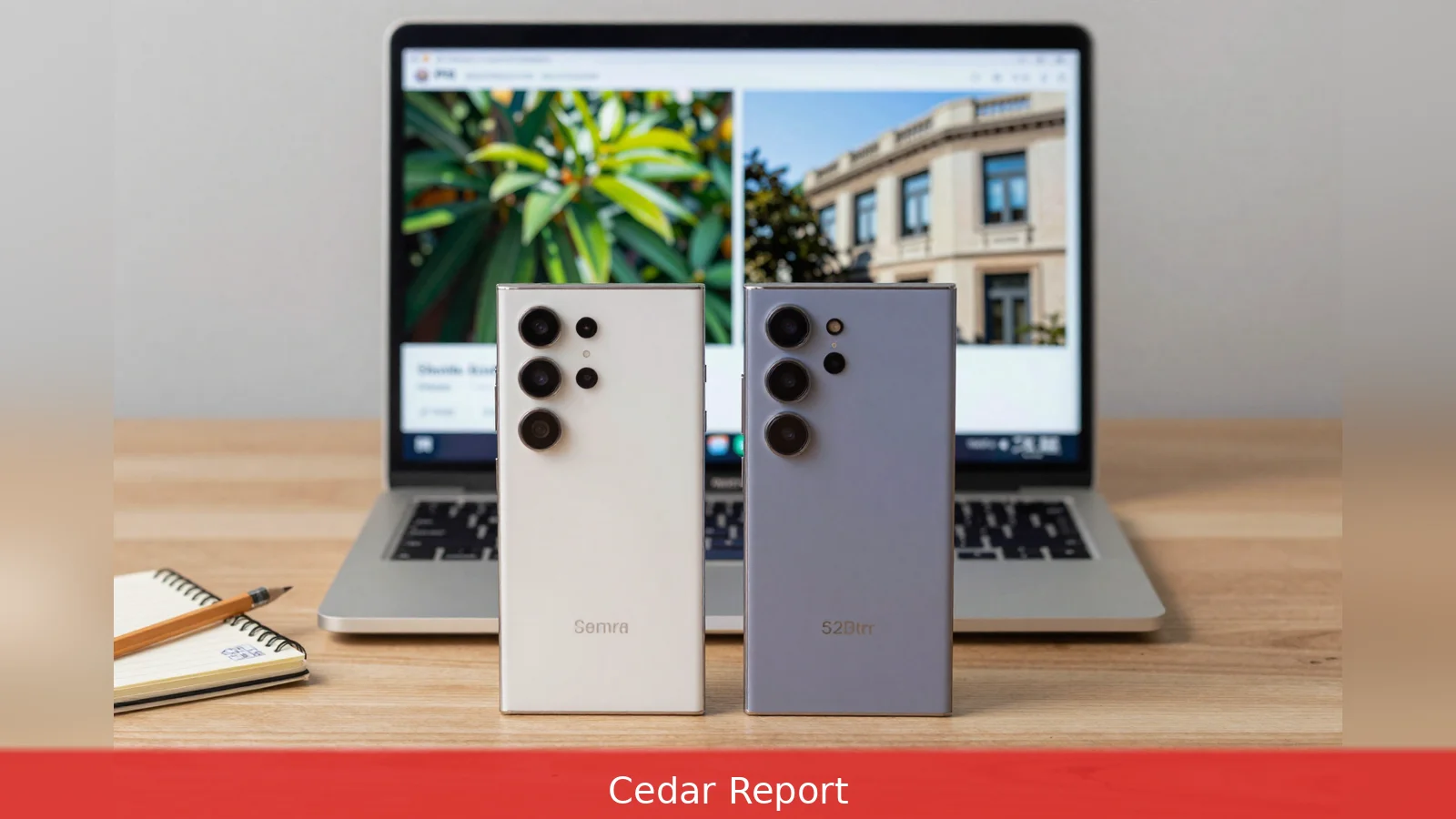
Pick the S26 Ultra if you crop, print or need real optical zoom. Choose the A37 if you mostly post to social feeds and want to save money. MobileSyrup’s camera shootout shows the gap comes from how you use the camera rather than from megapixels alone: the S26 Ultra pairs a 200-megapixel primary with two telephoto modules and wider dynamic range, while the A37 offers a simpler 50-megapixel primary, an 8-megapixel ultrawide and a 5-megapixel macro. Use the step-by-step method below to reproduce MobileSyrup’s comparisons and decide which camera matches your scenes and budget.
How can two phones with such different camera hardware both produce images that satisfy everyday users? MobileSyrup frames the contradiction by separating simple point-and-shoot needs from advanced zoom, low-light and colour-accuracy demands, and shows the outcome changes by use case.
1. Start by setting your photographic priorities
Priorities decide the winner more than raw megapixels. MobileSyrup recommends you begin by listing the scenes you shoot most often and the outcomes that matter: social posts, prints, cropping, telephoto framing or colour-critical work. First, write down your primary use. Second, note the one image you would crop deeply or print. Third, mark whether low-light shots are frequent. A short worked example: if most of your images end up on social feeds and you rarely crop, the A37’s punchy, share-ready processing is likely enough.
MobileSyrup’s testing separates two broad audiences. On one side are casual users who value convenience, bright colours and shareable files. On the other side are users who need extra detail, optical zoom reach and closer colour fidelity. If you fall into the second group, the outlet shows the S26 Ultra delivers visibly better results.
2. Understand the hardware differences that actually drive image quality
Sensor and lens layout are the concrete reasons images look different. MobileSyrup highlights the S26 Ultra’s clear technical advantage: a 200-megapixel primary sensor paired with two telephoto modules, one 10-megapixel 3x optical zoom and one 50-megapixel periscope with 5x optical zoom, plus a 50-megapixel ultrawide. The A37’s optics are a simpler triple module oriented to mid-range costs: a 50-megapixel primary, an 8-megapixel ultrawide and a 5-megapixel macro.
Those raw numbers set expectations MobileSyrup recorded in side-by-side images. The S26 Ultra’s larger sensor arrangement and additional telephoto hardware produce noticeably more detail and more realistic colour rendition in the outlet’s gallery. The A37 produces competent, vibrant images that are acceptable for sharing on social networks, but it lacks any optical telephoto to match the Ultra’s reach. MobileSyrup’s author warns there's no meaningful telephoto comparison because the A37 simply doesn't have that hardware.
Worked example: if you often zoom to frame a distant subject, test a 3x and a 5x shot. The S26 Ultra will provide true optical framing at those ranges, while the A37 will rely on digital zoom and cropping. That difference shows up in printed crops and when you push detail in editing.
3. Recreate MobileSyrup’s real-world comparison sequence
Follow the same diagnostic order MobileSyrup used to make your test apples-to-apples. First, shoot daylight frontal scenes to judge resolution and colour. Second, take edge-of-frame ultrawide shots to test distortion and dynamic range. Third, capture medium-range subject isolation to assess bokeh and subject separation. Fourth, attempt telephoto framing at 3x and beyond, where only the S26 Ultra has optical reach. Fifth, photograph low-light scenes to compare noise control and highlight recovery. MobileSyrup concentrated on the primary camera’s point-and-shoot experience and included one ultrawide comparison.
Practical setup tips based on the outlet’s approach: use the phones’ default camera apps and leave scene or AI filters off to prioritise out-of-the-box results. Keep both phones at the same distance from the subject and shoot from the same vantage point. If possible, mount both phones on a tripod to remove hand-shake variables when comparing detail. For a worked example, place the phones side-by-side and photograph a textured subject such as building masonry or fabric under bright daylight, then view the crops at 100 percent on the same display to judge fine detail.
MobileSyrup’s published gallery shows the S26 Ultra delivering more detail and a wider colour range across these scenes, while the A37’s images remain serviceable. For video, the outlet focused on stills rather than an exhaustive video benchmark, so consult the phones’ published video capabilities for frame-rate or resolution needs if video is central to your decision.
4. Include software, processing and convenience features in your tests
Processing matters. MobileSyrup emphasises that the difference between an acceptable phone camera and a superior one isn't only hardware but how the phone processes images. The S26 Ultra benefits from flagship-level processing that preserves detail and offers more natural colour, while the A37’s processing tends toward punchier, share-ready tones that still satisfy casual users.

When you test, check these specific items: First, look for RAW capture availability and test a RAW file alongside the JPEG to see how much editing headroom you get. Second, test exposure and white-balance override in both camera apps to see whether manual controls give you the control you need. Third, examine multi-frame HDR handling by shooting high-contrast scenes such as a person against a bright sky; compare highlight retention and shadow detail. MobileSyrup centred its comparison on point-and-shoot outcomes, so prioritise default results before deep-diving into pro modes.
Worked example: shoot the same sunset scene with both phones on default settings, then capture a RAW file on the S26 Ultra and a RAW file on the A37 if available. Import both into the same editor and compare how much highlight and shadow information each RAW file preserves. MobileSyrup’s narrative shows the S26 Ultra offering more realistic colour and dynamic range in comparable shots.
5. Balance price, support and long-term value
Budget and updates influence the decision as much as camera performance. MobileSyrup frames the S26 Ultra and A37 as phones for very different buyers: the S26 Ultra as a high-end tool for those who want top-tier camera performance, and the A37 as a budget-friendly option that covers core smartphone photography for most people. Retail pricing examples in the available comparisons show major list-price gaps between flagship and mid-range models, and MobileSyrup explicitly notes that the A37 may be good enough for people who mainly use a phone for social media, calls and video streaming.
Factor long-term software support into the purchase calculus as well. The brief notes comparison sites list different update expectations for each model, and those timelines affect value over the device’s usable life because longer update windows can keep camera improvements and security patches coming. Worked example: if a longer update schedule matters to you, add the expected support window as a weighted score in your decision grid when comparing total cost of ownership.
6. Translate results into a decision grid you can use in-store
Score the scenes that matter rather than tallies of total pixels. MobileSyrup’s practical recommendation is to score each phone on categories that match your workflow: detail, colour, dynamic range, zoom, low-light handling and video. Assign heavier weight to the categories you prioritise. If cropping and printing are crucial, give detail a higher multiplier. If you mostly post online, weight colour and out-of-camera punch more heavily.
Concrete scoring example: First, assign each category a 1 to 5 importance score based on your habits. Second, rate each phone 1 to 5 in each category after completing the tests described above. Third, multiply and total the results. The phone with the higher total in your personalised grid is the one that fits your needs. MobileSyrup’s conclusion is the same: choose the S26 Ultra if your workflow includes cropping, printing large images or heavy telephoto use; choose the A37 if social posting and everyday snapshots dominate and you want to save money.
7. Validate with side-by-side samples and a hands-on check
See the differences in real life. MobileSyrup published sample images and explicitly limited the written comparison to the primary camera’s point-and-shoot experience while including one ultrawide comparison. The most concrete next step the outlet provides is to study those side-by-side photos or recreate the same shots with the phones where possible.
Use a large, colour-accurate display to judge fine detail and tone reproduction. If you can’t reproduce a shot in person, view MobileSyrup’s gallery on a desktop or tablet and zoom into crops to compare texture, noise and colour fidelity. Worked example: open the published images at full resolution and compare a foliage crop and a building façade crop. The S26 Ultra’s images should show more recoverable detail and subtler colour transitions according to MobileSyrup’s samples.
Finally, perform a short hands-on in the retailer aisle: test the camera apps for responsiveness, try a quick zoom, and shoot a low-light scene in the store if possible. Those convenience checks often decide whether a flagship camera feels worth the premium in daily use.
In Short
- The S26 Ultra is the technical leader, with a 200-megapixel primary, two telephotos and a 50-megapixel ultrawide, and it produces more detail and more realistic colour in MobileSyrup’s gallery.
- The A37 uses a 50-megapixel primary, an 8-megapixel ultrawide and a 5-megapixel macro, and delivers vibrant, share-ready images that cover most casual needs.
- Reproduce MobileSyrup’s sequence: daylight frontal, ultrawide edge shots, medium-range subject isolation, telephoto framing where applicable, and low-light scenes, then score the phones by the categories you weight most.
- Factor in price and expected software support when deciding whether the S26 Ultra’s extra hardware justifies the premium for your workflow.
Related Articles
- 10 Steps to Prove You're a Builder in Tech Interviews
- Egypt one win from World Cup round of 32 vs Iran
- CRA clearance certificate: protect executors from tax liability
Workflow decides it: buy the S26 Ultra for cropping, large prints and optical telephoto reach; buy the A37 for social-first photography and lower cost. The single concrete divider between them is the S26 Ultra’s 200-megapixel primary sensor.
This article was created with AI assistance.


