
Only 25% of Canadians likely eligible completed a Disability Tax Credit application, even though 96.6% of completed files were approved, the Canada Revenue Agency reports. That gap leaves large numbers of households without immediate tax relief and blocks access to downstream programs such as registered disability savings plans and the Canada Disability Benefit. The CRA advisory committee singled out a complex Form T2201, low awareness, difficulties reaching CRA call centres and clinician misconceptions as barriers. The agency expects applications to rise as the new benefit increases demand.
The headline number matters more than the rhetoric. If only one quarter of likely eligible people finish a Disability Tax Credit application, the tax system and disability supports are failing on two fronts: capture and connection. Capture, because many who would qualify never get the immediate tax relief. Connection, because a valid DTC certificate is the gateway to other federal and provincial programs that now include a new cash benefit worth up to $2,400 a year for low income adults aged 18 to 64.
Why so few apply despite high approval rates
The Canada Revenue Agency's 2024 disability advisory committee report lays out the mechanics. Completed DTC submissions were approved 96.6% of the time, yet completion rates are low. Only 24% of online DTC applications reached completion, and among people who held a DTC certificate only 64% actually claimed the credit in 2022, the committee reported. That gap suggests paperwork, timing or awareness problems even after medical certification.
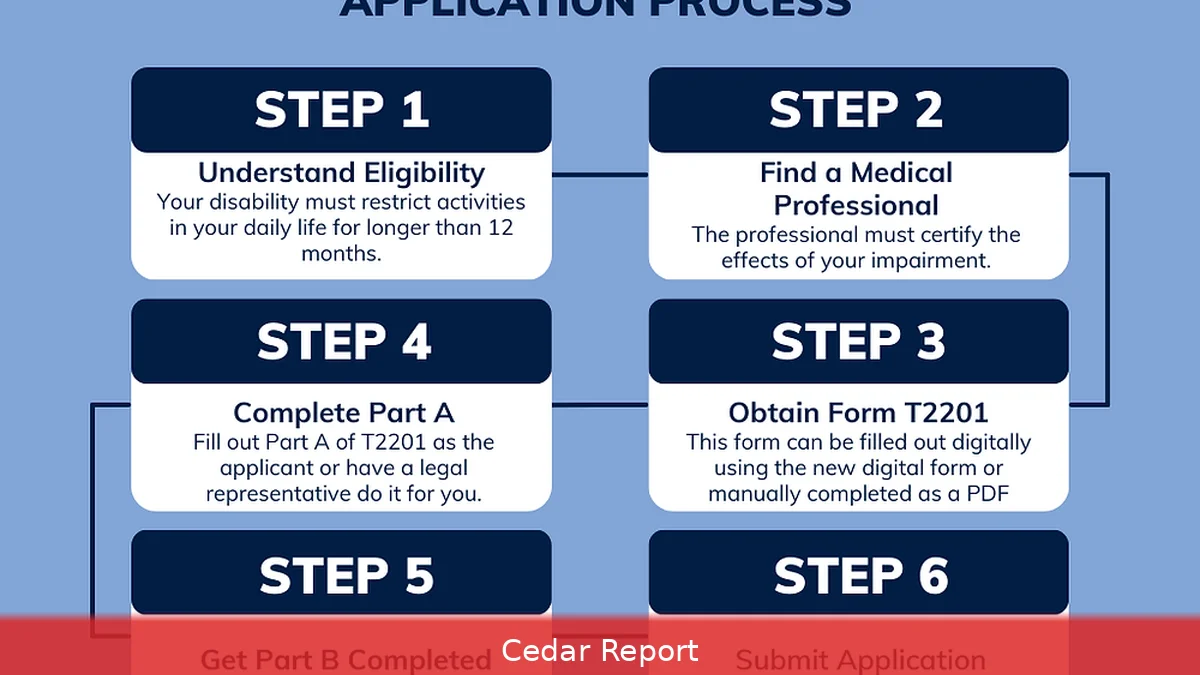
The application form itself is central to the problem. Form T2201 splits into two parts: Part A is the applicant's section and Part B must be filled by a medical practitioner with clinical detail. The advisory committee told the CRA that the form is complex, that contact with CRA call centres can be difficult, and that many clinicians are uncertain about how to assess and certify eligibility. Low awareness among potential applicants compounds the issue. The committee recommended targeted outreach to hard to reach populations, partnerships with Indigenous communities and health authorities, and clearer guidance for practitioners to reduce incorrect discouragement of eligible patients.
Cost is another hurdle. The CRA's 2018 figures showed private DTC assistance companies commonly charge contingency fees in the range of 15 to 40% of the tax refund. CBC documented a case where a family paid more than $7,600 to a DTC advocacy firm, an amount the report described as equal to 20% of the refund plus GST. The federal government has estimated that roughly 75% of applicants use professional services such as lawyers or promoters to complete submissions. Firms that offer contingency based assistance argue they only charge on successful applications and that fees fund filing support and advocacy with medical professionals and the CRA. Critics and applicants call those fees a heavy burden on households that are often low income, and say the charges can negate much of the credit's economic value.

Why the DTC matters beyond a tax line
A valid DTC certificate does more than cut a tax bill. Recent federal policy changes increased the DTC's downstream importance. June 2022 legislation expanded eligibility to include impairment of mental functions and removed the former requirement that people with Type 1 diabetes demonstrate they spend at least 14 hours per week on insulin related activities.
The Canada Disability Benefit began payments in July 2025 and low income Canadians aged 18 to 64 with a valid DTC certificate became eligible for up to $2,400 per year under that program.
The DTC is also the key access point for registered disability savings plans, the home accessibility tax credit, certain child and student disability benefits, and for eligibility under the Canadian Dental Care Plan for uninsured adults and children under 18 within income limits. Those linkages mean the form and the certification process act as a funnel into many supports. The CRA told its advisory committee that as a result of the new Canada Disability Benefit it expects a substantial rise in DTC applications over the next five to six years.
Stakeholders disagree about fixes. The CRA committee pushed for simplification of the application and for centralizing processes, while noting some changes would require amendments to the Income Tax Act and cooperation with Finance Canada and Employment and Social Development Canada. DTC assistance firms defend contingency fees as necessary to fund outreach and casework. Disability advocates and applicants call for expanded free help and clearer practitioner guidance to reduce reliance on paid promoters. Each side frames the problem differently: some see procedural friction that can be engineered away, others see market failures that require public service to fill the gap.
My read is that policy design and implementation both matter. Simplifying Form T2201 and giving clinicians clearer, authoritative guidance would remove a major procedural barrier. At the same time, subsidised or free application support targeted at low income and remote communities would blunt the worst effects of contingency fees. The CRA's own recommendations point in both directions, but they also make clear that full reform will need coordinated action across agencies and likely statutory change.
Related Articles
- Stellantis stock down 30% as CEO unveils turnaround plan
- Bank of America survey: 3.3 sentiment, 54% favour international stocks
- Yields Jump to 5.06% and Test Stocks' Rally
The CRA expects a substantial rise in DTC applications as demand from the Canada Disability Benefit grows. Whether those additional applicants actually secure the credit will hinge on whether the CRA and partner departments simplify Form T2201, improve practitioner guidance and expand subsidized or free application supports.
This article was created with AI assistance.


