
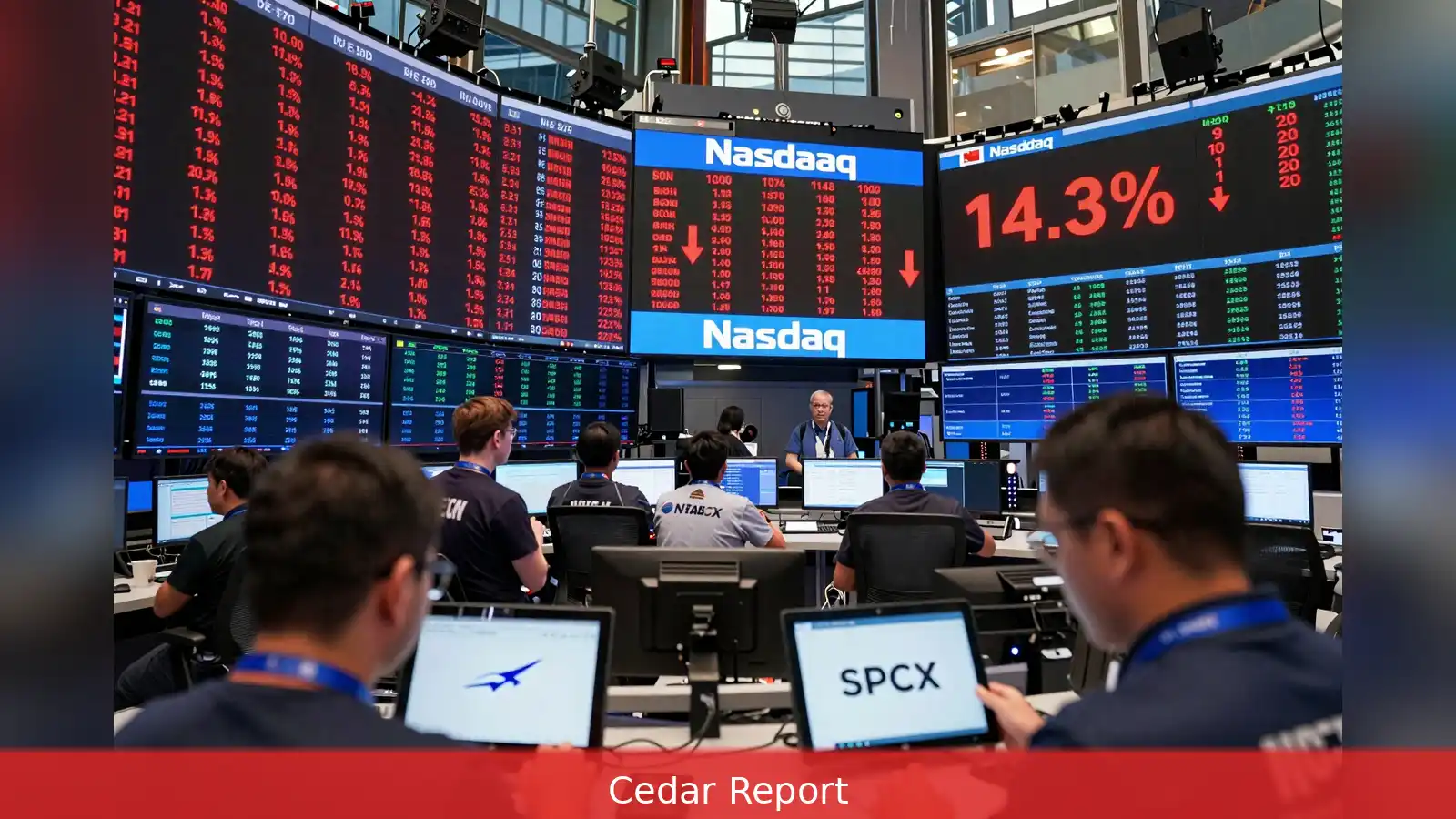
Friday's more-than-4% slide in the Nasdaq reads as a liquidity rotation into SpaceX's looming IPO, not the end of the AI-fuelled rally. The Nasdaq Composite fell as investors trimmed positions in hot technology and semiconductor names to raise cash ahead of the planned float. Broadcom led the rout, plunging about 14.3% after it trimmed its AI revenue outlook, The Guardian reported. Fundstrat managing partner Tom Lee told CNBC he expects the pullback to reverse after the float, saying markets will absorb the deal even if trading is choppy. SpaceX is set to begin trading under the ticker SPCX, and strategists point to the subsequent 90-day lock-up window as the next structural liquidity milestone.
The selloff concentrated in technology and semiconductor stocks, led by Broadcom's roughly 14.3% slide after the company trimmed its AI revenue outlook for the coming quarter.
Why the tech rout happened
Friday's retreat hit chip names especially hard. Broadcom's drop erased about $300 billion of market value in a single session, according to The Guardian. Other silicon names such as ARM and AMD also posted notable declines as traders rebalanced positions.
CNBC reported the Nasdaq's pullback and quoted fund managers and strategists who tied some of the selling to investors freeing up cash to participate in SpaceX's IPO. The dynamic is straightforward: large, headline-grabbing offerings can pull liquidity out of secondary markets as firms and wealthy clients reallocate capital toward a primary deal.
Why Tom Lee expects a reversal
The rotation looks temporary to Tom Lee, who made the point on CNBC's Power Lunch. But he argued the selling is driven by demand for SpaceX shares rather than a structural reversal in the AI trade, and he highlighted the scale of undeployed capital in the system. "There’s still 7 trillion of cash on the sidelines," Lee told the network, and he said he expects high-net-worth clients and institutions to use that liquidity to buy into the IPO.
Lee warned volatility is likely in the immediate lead-up to the listing, but he said the post-IPO period should be constructive for equities once those buyers move from private to public positions. That view rests on two linked assumptions: first, that much of the early demand for SpaceX will come from investors rotating into a newly tradable mega-cap; second, that not all early holders will immediately sell into the market when lock-ups expire.

Fundstrat has tried to quantify the supply risk and its limits. In reporting by CoinDesk, Fundstrat estimated that SpaceX together with anticipated listings from Anthropic and OpenAI could produce post-lock-up supply equal to roughly 5% to 6% of the S&P 500's market capitalisation.
That's a large mechanical number, but not necessarily a market-ending one if buyers step up.
For SpaceX in particular, CryptoBriefing relayed Lee's view that roughly $2 trillion of SpaceX stock could become tradable within about 90 days of the IPO. That kind of mechanical liquidity event could pressure prices if a large share of holders sold immediately. Lee counters that many early investors will choose to hedge or borrow against their stakes rather than crystallise taxable gains, and that issuers will actively manage communications and access to capital markets to limit disorderly moves.
MarketWatch provided specifics that give scale to the debate: SpaceX plans to list under the ticker SPCX with shares priced at $135, implying an initial market capitalisation near $1.75 trillion. Coverage of SpaceX's S-1 filing, summarized by CryptoBriefing, also highlighted the company's disclosure of 18,712 BTC in its corporate treasury, valued at about $1.29 billion as of March 31.
Lee drew an explicit contrast with the dot-com era, saying comparisons to the 1999-2000 lock-up expirations are misplaced. He argued that today's large investors, including family offices and pensions, are underallocated to public equities after years of favouring private markets, leaving room for rotation back into newly listed technology names. He added that companies like SpaceX will have ongoing funding needs and therefore an incentive to maintain constructive relations with public investors.
The market reaction this week shows both sides of that claim. Sellers moved first as they prepared for the IPO allocation process, and buyers may step in once the float clears and institutional allocations settle. How much of the mechanical supply from lock-ups turns into actual selling will determine whether this episode is a brief wobble or a longer re-rating of the sector.
Investors and strategists are already parsing the calendar and the mechanics: allocations, initial retail interest, and the three-month lock-up window that follows an offering are all set to define the near-term supply picture. That sequence is why some strategists are treating Friday's weakness as a timing event rather than a signal of the end of AI-driven demand for chips and software names.
Related Articles
- IPO rebound raises market-top risks after 1,035 peak
- Jim Curtis pulls $1.5-million Seaport condo off market
- Goldman Sachs: nine market indicators at 66th percentile
Watch the 90-day lock-up as the next structural liquidity milestone. The market's reaction to SPCX's initial trading and any post-listing selling will show whether buyers rotate back into public technology names.
This article was created with AI assistance.


