
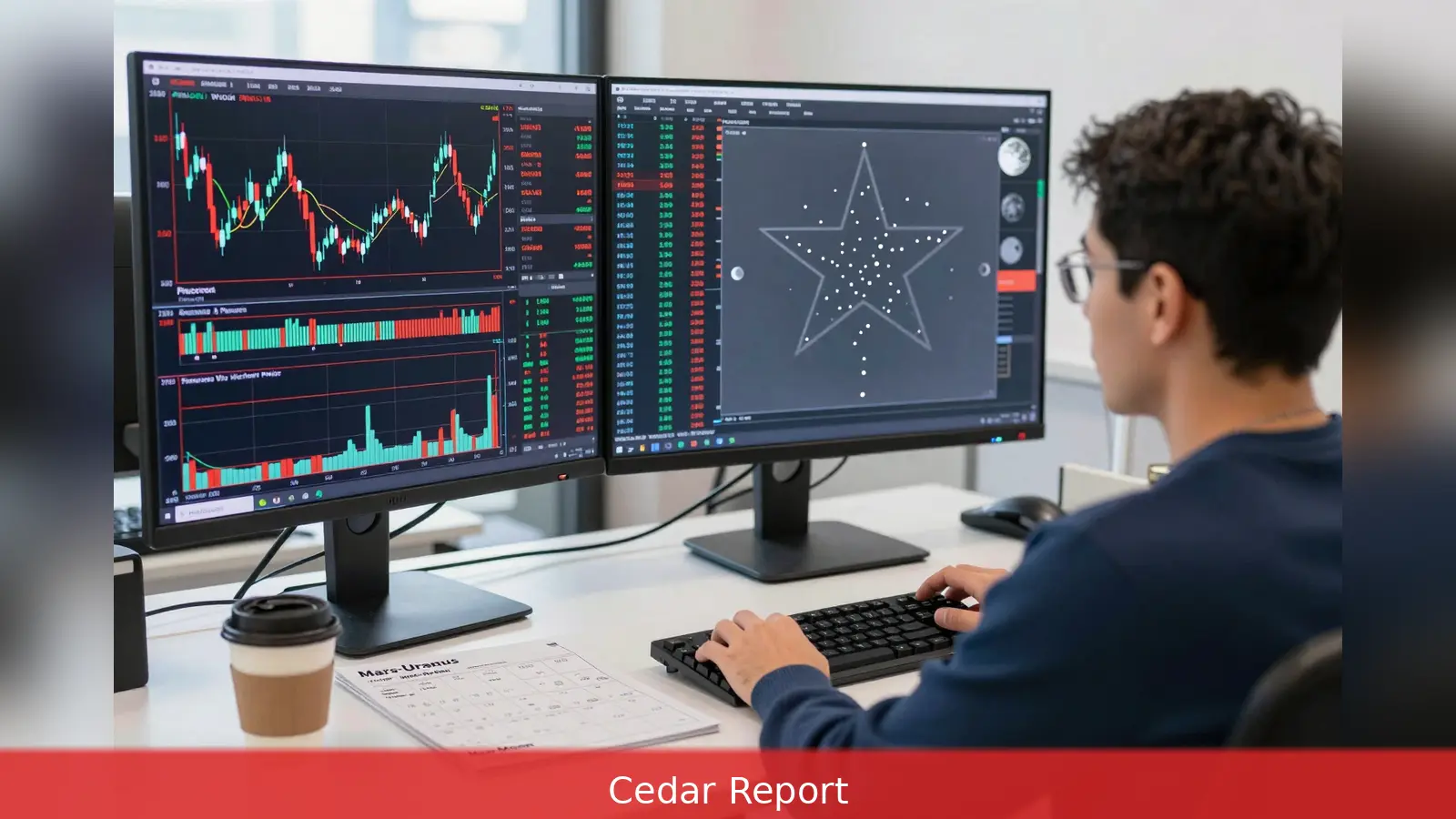
Sharper, more volatile opens can be tradable if you plan for them, because financial astrology links specific transits and lunar cycles with elevated intraday moves. Traders who align explicit execution and risk rules to defined Planetary risk windows improve timing and limit tail exposure, the guidance says. That timing layer works as an overlay to normal volatility tools: use neutral option structures when you expect unpredictable spikes, and shorter-dated directional contracts when lunar phase signals point to a clear breakout. As a practical next step, the astrology material recommends backtesting the windows you will track against intraday price, volume, and order-flow data.
Trades that open at the market open with explicit execution and risk rules perform better when planetary windows indicate elevated short-term volatility, because astrology writers commonly associate Mars-Uranus aspects, Mercury retrograde periods, eclipses, and lunar phase transitions with sharper, less-predictable price action. Financial astrology sources describe Mars-Uranus contacts as coinciding with sudden, unpredictable spikes, Mercury retrograde as a period of miscommunication and erratic sentiment that can produce false breakouts, lunar eclipses as precedents to reversals, and New Moons and Full Moons as short-term markers for breakouts and overextensions respectively. Those same writers recommend applying this timing layer to option strategies since options decay over time and reward precise entry and exit timing.
1. Define and calendar the risk windows
First, assemble a repeatable source list for the planetary events you will treat as windows. Keep the taxonomy narrow and consistent: major planet-to-planet aspects that involve outer planets and faster action planets (for example Mars-Uranus), Mercury retrograde phases, Solar and lunar eclipses, and lunar phase transitions such as New Moon and Full Moon. If you use intra-day planet-hour systems sometimes called Hora timings for finer intraday timing, add them to the same calendar but treat them as finer-grain windows rather than replacing the broader events.
Treat each event as a window, not a single moment. Document the start and end dates you will consider active for your instruments. Assign each event a simple volatility score and, when the astrology source provides one, a typical directional bias. Don't substitute those biases for fundamental or technical analysis. Instead, keep the planetary classification as an explicit timing overlay that triggers a checklist of microstructure and volatility confirmations before any capital is committed.
Worked scenario: pick three event types to start. First, flag Mars-Uranus contacts, assign them a high volatility score. Second, mark Mercury retrograde stretches as periods for cautious entry and potential false breakouts. Third, treat New Moons as possible breakout windows and Full Moons as potential overextension windows. Save more exotic timings for later when you have an evidence record.
2. Translate windows into tradable setups and instruments
Next, map each window type to an instrument set and a structural approach. The practical guidance in the astrology material divides into two tracks: options-based approaches and cash or futures entry tactics. For unpredictable spikes, the writers recommend neutral option structures, for example strangles or wide straddles, because those structures profit from sudden IV expansion. When a lunar phase signal favors a directional breakout, use directional weekly or bi-weekly contracts, allowing you to target a near-term move without paying for long-duration time decay.
When the planetary climate points to limited movement, consider defined-range spreads such as iron condors.
Complement options with conventional choices from the volatility education material: long puts for downside protection when you fear abrupt falls, pairs trading or swing trades for directional conviction, and conservative sizing on earnings or event plays. For market-open execution specifically, prioritise instruments and series with liquid opening auctions and tight bid-ask spreads so slippage is manageable. For options, prefer strikes and expiries with strong open interest and tight spreads to avoid execution cost surprises at the open.
Worked scenario: if a Mars-Uranus contact and a New Moon overlap, plan a neutral strangle in a weekly series with high open interest. If a Full Moon coincides with a low-volatility planetary climate, consider an iron condor sized to limit risk to a predefined dollar loss.

3. Set pre-open rules and the volatility signature to watch
Before the bell, define the market-open signatures that will confirm the planetary window is manifesting as tradable volatility. The market-microstructure guidance emphasises watching for large intraday candles with long wicks, price gaps between prior close and open, sudden increases in trade volume, and widening of implied volatility on option chains. Deploy a real-time liquidity view or heatmap to see whether depth is pulling back or whether orders are sweeping the book. These are the live confirmations that make a calendar tag actionable.
For options, monitor implied volatility and the skew across strikes. A rapid IV expansion at or before the open is the precise signal that neutral volatility structures will inflate in value, while IV compression suggests fading a breakout. Combine those live indicators with the calendared planetary window rather than relying on the calendar alone. If the market lacks the expected microstructure signals, stand aside or reduce size.
Worked scenario: your calendar shows a lunar phase flagged for a breakout. At 09:25, you see a 3 percent gap up in the underlying, a doubling of opening volume, and a visible IV lift in the front-week chain. Those signals validate moving from planning to execution.
4. Size, execute, and limit exposure at the open
Size and execution rules are central because theta, slippage, and tail risk are concentrated at the open. The astrology guidance stresses timing short-dated contracts when you expect intraday or multi-day spikes, since short expiries magnify the effect of IV moves but also magnify theta. When using neutral option structures intended to profit from a volatility jump, cap position size so that the maximum adverse move in the underlying produces a predefined loss measured in dollars and percentage of portfolio. For directional plays, prefer defined-risk spreads or protective hedges such as buying puts rather than taking naked exposure.
For cash or futures entries at the open, use limit orders or staged marketable limit orders to avoid execution at the far edge of the opening auction. Predefine stop levels or a volatility-based trailing stop to protect against continuation moves that exceed the expected window amplitude. The market-volatility material emphasises the psychological element: keep a checklist with the entry conditions, stop, size, and allowed slippage so that decisions at the open are mechanical rather than emotional.
Worked scenario: you place a marketable limit order for a cash entry that stages execution across three price levels into the opening auction, and you size the options position so the worst-case dollar loss equals the maximum you allow for a single planetary-window trade.
5. Manage post-entry adjustments and exits
After entry, manage positions by tracking the interaction between implied volatility and price. If you entered an options structure to capture a volatility spike and IV rises as anticipated, the recommended exit is to reduce position size or close while IV remains elevated and before theta and mean reversion erode gains. If a directional bias materialises and you prefer to run the trade beyond the initial window, convert to a defined-risk spread or hedge tail risk with additional options rather than add naked exposure.
If the planetary window was signaled but real-time order-flow and volatility metrics don't confirm unusual action at the open, the recommendation is to stand aside or use scaled, small entries. The astrology sources warn against forcing trades based only on calendar alignment. In practice that means: if the calendar says risk is higher but the order book, volume, and IV don't align, step back and let the trade come to you.
Worked scenario: IV spikes immediately after the open and you take profits on the upper half of a strangle while leaving a reduced, hedged position to capture any continuation during the next session. Alternatively, if the microstructure signature never appears, you close any tentative small entry and log the non-confirmation.
6. Institutionalise risk controls and review outcomes
Finally, make the process repeatable. Keep an event log that tracks which planetary windows were active, what microstructure signals appeared at the open, the trade taken, and the outcome. Over time that produces objective metrics such as win rate, average return per window, average slippage at open, and realised gamma exposure. The volatility-education material stresses that volatility is an opportunity and not a guarantee, so the log forces discipline and reduces hindsight bias.
Backtest the lunar phases and discrete planetary windows you plan to trade against historical intraday price and volume data, and pair those backtests with microstructure-aware simulation so opening auction execution and spread dynamics are modelled accurately. Maintain a documented position-sizing rule that limits any single planetary-window trade to a small fraction of portfolio capital. Those two steps convert a calendar overlay into a measurable trading tactic rather than an assertion.
Worked scenario: after three months of trading, review the log and discover average slippage at the open is larger than expected. Adjust the pre-open execution rules to require slightly more favourable liquidity conditions before committing full size.
The synthesis of the sources yields a clear operational priority: treat planetary signals as a timing overlay on top of conventional volatility detection and order-flow confirmation. Use neutral option structures when you expect unpredictable spikes, and shorter-dated directional options when the signal points to a clear breakout aligned with a lunar phase or transit. Rely on real-time microstructure tools to confirm that the market-open is producing the amplitude and liquidity conditions that justify committing capital. Keep trades mechanical with checklists and a documented sizing rule so that the open is executed by rules, not by impulse.
Related Articles
- 10 Steps to Build a Financial Astrology Watchlist
- Direct deposit for Canada Child Benefit: 6 ways to sign up
- 9 Steps to Improve Personal Loan Approval Odds
The immediate next step recommended by the astrology material is concrete: run a focused backtest of the lunar phases and the specific planetary events you plan to track against your chosen instrument, using historical intraday price, volume, and the order-flow or depth tools you will trade with.
This article was created with AI assistance.


