
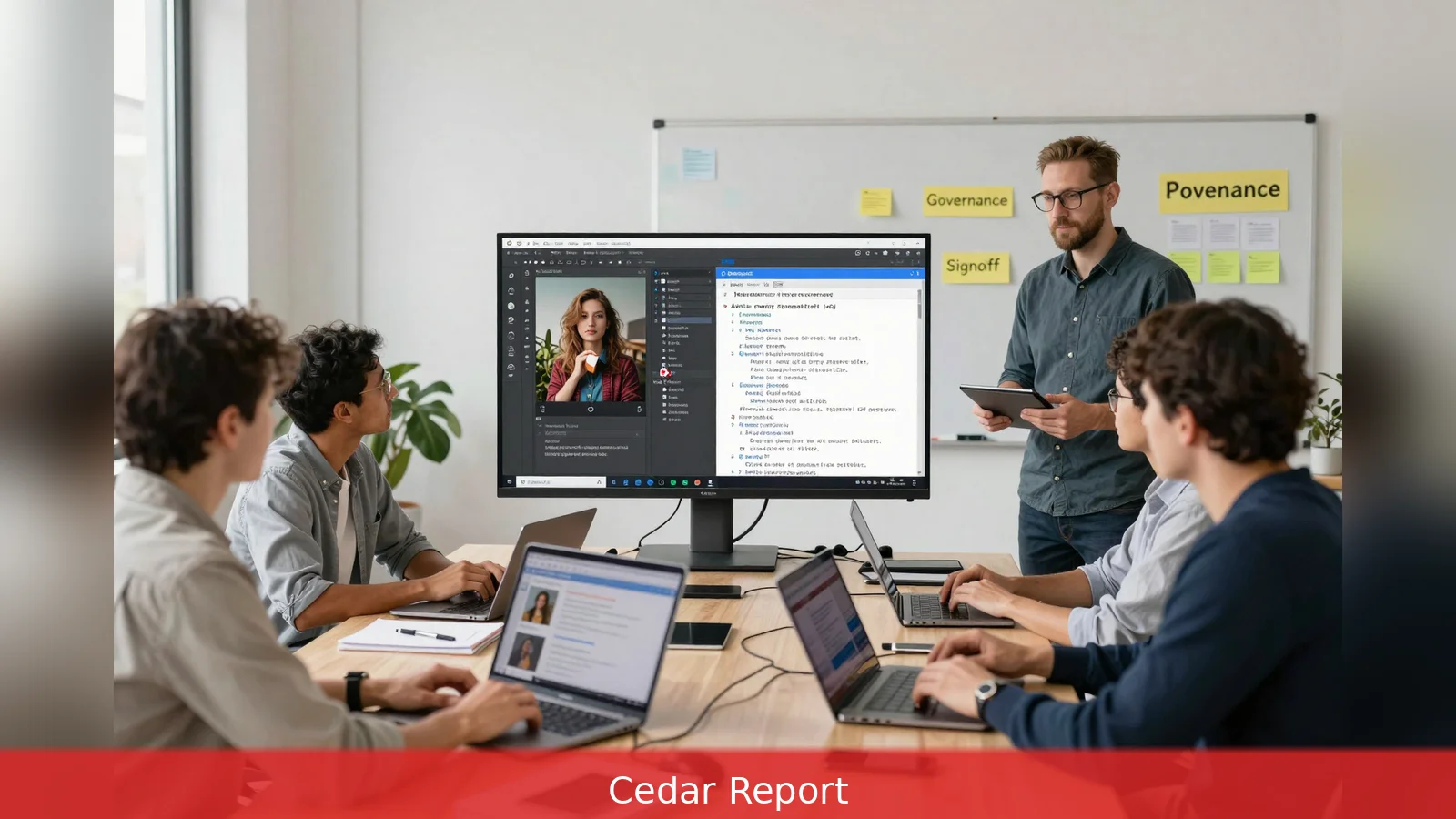
Generative AI can make creative work better, but only when teams pair pilots with firm governance and clear labour protections that keep creators central. A CDW/Adobe-related industry report finds 83 percent of creative professionals already use generative AI, 74 percent use it in their personal life, and 20 percent say an employer or client requires its use. Two thirds of users report improved content quality and 58 percent report higher output, with many noting time savings on routine tasks. Canadian policy is moving in parallel: the Government of Canada’s Guide on the use of generative artificial intelligence and a Canada Media Fund review frame practical benefits alongside legal, privacy and labour guardrails.
If generative AI can speed production and raise quality, how do teams keep creators central rather than sidelined? Practice plus policy matters: pick problems the tool actually solves, manage legal and ethical risk up front, and redesign workflows so human authorship remains clear and valued. This guide lays out a nine-step sequence that creative teams and cultural organisations in Canada can apply, with practical examples and the specific stakeholder actions the Government of Canada recommends.
1. Define the creative objective, not the tool
Define the objective on day one. Are you after exploratory idea generation, faster iteration, draft-to-finish production, or better metadata and accessibility? Each objective points to a different class of model and a different pilot design. Image models such as DALL-E, Midjourney and Stable Diffusion are typically the best fit for concept art, moodboards and visual prototyping. Large language models like ChatGPT, Copilot and LLaMA are useful for drafting, metadata generation and copy variants. Audio and voice tools suit vocal design and sample creation, while code-generation assistants speed tooling and automation.
First, document the creative outcome you expect. Second, sketch the human roles that must remain in charge of tone, attribution and final signoff. Third, define the minimum quality threshold that would make the tool worth adopting for that work. A clear objective stops organisations from chasing every fashionable model and helps when it's time to measure results.
2. Map legal and ethical risk before you pilot
Map the risks before anyone hits the button. The Government of Canada’s Guide on the use of generative artificial intelligence advises federal institutions to follow a risk-first approach: don't deploy generative AI where you can't manage privacy, security, intellectual property or human rights obligations. For cultural organisations, that means asking whether outputs will process personal information, reproduce copyrighted works or implicate moral rights, or generate content that could be discriminatory or otherwise harmful.
Practical steps are procedural and convening based. First, convene legal counsel, privacy and security specialists, the Office of the Chief Information Officer at the Treasury Board of Canada Secretariat, bargaining agents and service users when the work will be public facing. Second, map the data flows that will touch the model during training, fine-tuning or inference. Third, set clear stop rules: types of content or audiences for which the model can't be used without escalation.
Worked example: a public broadcaster considering AI summaries for news pages maps whether any author-submitted content includes personal or sensitive data. If so, the project requires a privacy impact assessment and signoff from the named stakeholders before a pilot starts.
3. Choose the model class and deployment architecture
Match model tradeoffs to the use case. The federal guide names both proprietary and open-source models and highlights different tradeoffs in cost, performance, scalability, security, transparency and vendor support. For fast creative experimentation, a cloud-hosted proprietary model can be speedy and easy to use. For sensitive data or regulated services, prefer architectures that give local control, auditable logs and documented provenance.
First, decide if your pilot needs local control of training data. If it does, an open-source model fine-tuned on rights-cleared material may be the right path. Second, if speed and model polish are the priority, a proprietary cloud model might be justified, but include contract clauses that address training data provenance and licence terms. Third, document the decision and the reasons so audits and bargaining agents can review them.
4. Design human-in-the-loop workflows and preserve authorship
Keep humans in the loop at well-defined checkpoints. The Canada.ca guidance urges that automated use be limited to where risks can be controlled, and that control is exercised through human oversight. Define who reviews AI outputs, who has final editorial authority, and where provenance and attribution are recorded.
First, build a simple decision map: which steps are automated, which are assisted, and which are strictly human. Second, require explicit human signoff for public release or client delivery. Third, attach provenance metadata to the file or asset that records the model used, the model version, the prompt and the human editor who approved the final output. Worked example: an animation studio uses AI for key-frame interpolation but requires an animator to approve motion arcs and credit the animator as the author of the finished sequence.
5. Secure data and intellectual property governance
Treat training and fine-tuning data as governed assets. The federal guide ties generative AI use to existing privacy, security and intellectual property laws. Before fine-tuning, confirm who owns the data, whether the rights cover reuse and derivative works, and whether third-party licences are needed.

First, create a data inventory that lists sources, licences and consent status. Second, where commercial or personal information is present, implement technical safeguards such as access controls, encryption and logging. Third, for any curated dataset intended for fine-tuning, store provenance records and licence documentation with the dataset.
6. Pilot with metrics tied to creative goals
Measure against the objective. The CDW/Adobe-related report finds measurable gains: two thirds of creative pros who use generative AI say it helps them make better content, and 58 percent report increased quantity. Define baseline KPIs for the work you plan to replace or augment, and measure quality uplift, content velocity and time-to-delivery during a small pilot.
First, choose a small, representative project and collect baseline metrics on time spent, number of iterations and satisfaction with final output. Second, run the AI-assisted workflow and compare the same metrics. Third, evaluate subjective quality with blinded human review where possible, and log both prompts and post-generation edits so you can trace where the tool added value.
7. Protect creators and clarify compensation
Protect labour and credit. National sector data show cultural and information industries are among the early adopters of AI, and many cultural businesses report using AI to accelerate creative development rather than to replace staff. Still, workers and bargaining agents are legitimate stakeholders. Build contractual clarity about authorship, reuse rights, and credit in any work that uses AI.
First, update contracts to specify whether AI-assisted work is considered human-authored and what reuse rights clients receive. Second, where staff are unionised, engage bargaining agents early to negotiate protections and compensation rules. Third, consider creative-pay adjustments when AI materially increases output expectations.
8. Select explainability, provenance and audit strategies
Log for audit and explainability. For public or regulated creative uses, keep records that show prompts, model versions and post-generation editing so provenance can be demonstrated. The Government of Canada’s Guide stresses coordination and documentation; these practices support compliance with IP and privacy obligations and help defend editorial choices.
First, put in place a simple logging standard that records the model, model version, the prompt text, date and the human editor. Second, store edits and the final asset with that log. Third, develop a short disclosure statement for public-facing work that explains the role of AI and notes the human responsible for the final output.
9. Iterate governance as policy and technology evolve
Treat governance as living. The federal guide itself will be updated periodically and Canadian policy continues to evolve with new funding and programming for workforce supports and AI safety. Use pilot learnings to refine vendor evaluations, data controls and human-review thresholds.
First, schedule governance reviews at regular intervals and after each pilot. Second, keep an issues log that records harms or near misses and the corrective steps taken. Third, update contracts, training and signoff procedures based on those lessons.
Practical notes and examples
Prompt engineering is a practical skill across image, text, audio and code generation. Small changes to instructions change outputs dramatically, so train teams to write concise, testable prompts and to iterate quickly. Co-creative interfaces that allow rapid edit-feedback loops are already used in animation, sound design and music composition to remove tedious manual steps such as key-frame interpolation or sample splicing. Where a team needs a bespoke voice or consistent image style, fine-tuning with curated, rights-cleared material is an option, but it carries the tradeoffs the Government of Canada’s Guide warns about: higher control at the cost of more governance and proof of rights.
Public and client work should prioritise transparent disclosure policies and maintain human editorial attribution. Convene the stakeholders named in federal guidance before deployment: legal counsel, privacy and security experts, the Office of the Chief Information Officer at the Treasury Board of Canada Secretariat, bargaining agents, advisory groups and end users. That convening is the documented first action the Government of Canada’s guidance prescribes before deployment.
When procuring cloud-hosted services, require vendors to document model training data provenance, data retention policies and support for audit logs. If a project uses open-source models, document the licence terms and any downstream obligations. For sensitive or regulated work, prefer architectures that allow on-premise deployment or private cloud hosting so you can control logs and access.
Worked example: a cultural organisation that wants to produce AI-assisted audio samples for a commercial album chooses to fine-tune an open-source audio model using rights-cleared voice material. The organisation stores licence agreements with the dataset, records the fine-tuning run, and requires producers to attach provenance metadata to each sample used in release masters.
Implementation checklist
First, set the objective and measurable KPIs. Second, convene the named stakeholders from the Government of Canada’s Guide and document their signoffs. Third, choose the model class and deployment approach that balances speed and control. Fourth, design human-review gates and authorship rules. Fifth, log prompts, model versions and edits for provenance.
In short
First, pick the problem you want AI to solve, not the shiniest model.
Second, map legal and ethical risks and convene legal, privacy and bargaining stakeholders before piloting.
Third, design human-in-the-loop checkpoints, log provenance and clarify compensation and authorship in contracts.
Related Articles
- Best AI note-taking app 2026: 8 steps to the right pick
- Google Earth flight simulator lands in browsers, no install
- 6 Steps to Trade Market-Open Volatility During Planetary Windows
The high level of adoption among creative professionals makes careful governance, clear labour protections and measured pilots the practical priority for creatives and cultural institutions in Canada.
This article was created with AI assistance.


