
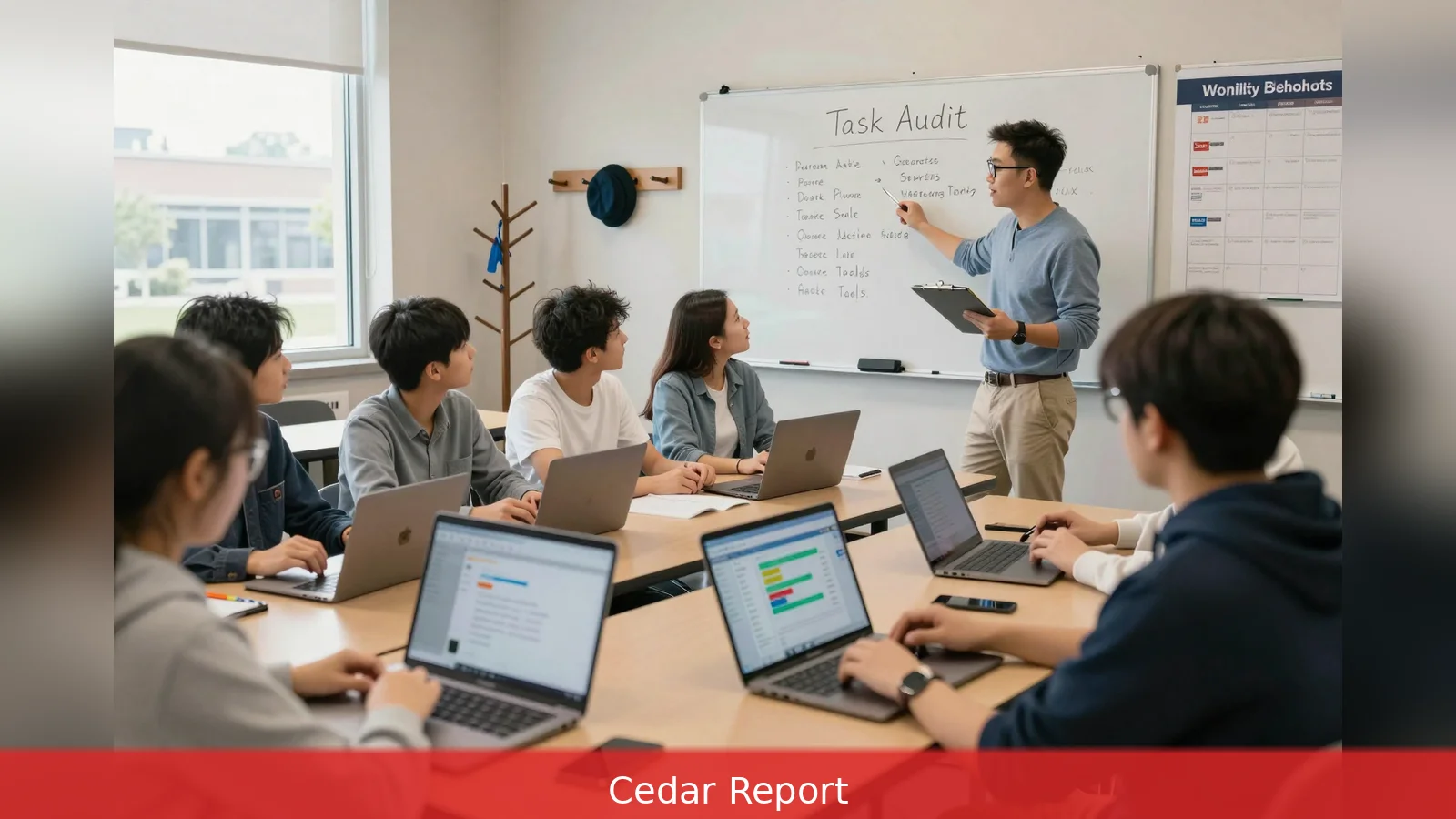
Faster, more consistent practice is producing measurable learning gains because schools are using AI teaching assistants to take on repetitive tutoring and assessment. A peer-reviewed mixed-methods study published on Springer found learners supported by AI scored higher on a targeted language task than those supported by human teaching assistants or by no assistant, with mean scores of 24.23 for the AI condition, 20.26 for the human-TA condition and 16.30 with no assistant. The software driving that change answers questions around the clock, grades routine work, tracks mastery and generates individualized exercises, while human assistants continue to supply emotional support, contextual judgement and complex pedagogical decisions. For educators and administrators, the practical next move is straightforward: run a classroom task audit to identify low-complexity, high-frequency tasks for an initial AI pilot.
Faster, more consistent and highly personalized practice is becoming possible because advances in adaptive algorithms and natural language systems let software handle routine tutoring and assessment at scale.
1. Audit classroom tasks and separate routines from judgement
Start with a simple record of what actually happens in class. Identify the frequency of tasks, the typical turnaround time students expect and how emotionally sensitive each interaction is. That Task audit is the single concrete step every source recommends as the right place to begin.
First, count routine, high-volume activities such as grading objective items, answering repeatable factual questions, tracking completion and generating practice items. The practitioner pieces and blog summaries the briefing reviewed consistently name those tasks as low-risk targets for automation. Research that measured gains in a language exercise implied similar targets: AI produced measurable improvement when it supplied frequent, structured practice and feedback.
Second, flag interactions that require interpretation, motivation or pastoral care. These are instances where human assistants read subtle student signals, deliver encouragement, diagnose unusual misconceptions and manage classroom dynamics. A worked example: imagine a week where 120 quick quizzes are scored, 40 procedural questions are asked in office hours and five students seek help with motivation. The audit will show automated scoring and instant answers could cover the 120 quizzes and many quick questions, while the five motivational meetings remain with humans.
2. Characterize complexity and emotional sensitivity
Not all tasks are equal. Use the audit to build two simple axes: task complexity and emotional sensitivity. The briefing points to clear evidence that those axes predict whether students will accept AI help. A separate empirical article used interviews and a survey to show that higher problem complexity reduces students' willingness to use AI, while higher social anxiety increases it. That means AI is well suited to predictable, low-stakes tasks and students who prefer not to interact face to face.
Practical scenario: a language class where students need repetition to master verb forms. Complexity is low, emotional sensitivity is low, and many learners prefer immediate, private practice. That maps cleanly to an AI role. By contrast, when a student misunderstands a central concept and becomes frustrated, the situation scores high on both axes and should escalate to a human assistant.
3. Choose an integration model and set escalation rules
There are three broad deployment patterns to consider, and they're often combined in practice.
First, the Supporting role: AI supplies routine feedback and practice while human assistants handle escalation and mentorship. Research supports this pattern for language learning tasks because the strongest gains arrived when AI supplied frequent practice and the human role remained supervisory.
Second, the Access-extension role: AI extends learning beyond class hours, making answers and exercises available 24-7 while humans lead synchronous instruction. Third, the Formative-assistant role: AI generates drafts, diagnostics or practice items that a human then reviews and refines. A worked example for an integration plan: assign your AI to grade multiple-choice quizzes, auto-generate three practice drills per student each week and answer factual queries in a class Q and A forum. Create explicit escalation rules that require a human response when a student reports confusion, when an AI flags repeated errors for the same learner, or when a question contains emotional language or mentions wellbeing.

Sources emphasise that students form different kinds of trust. One line of research modelled trust as ability trust, benevolent trust and integrity trust, mapped to response quality, service attitude and communication skill. Those forms of trust predict whether students favour AI or human support, so your escalation rules should reflect trust thresholds as well as task complexity.
4. Implement governance, monitoring and teacher training
Deploying AI isn't plug and play. Monitor response quality, communication ability and response time, because the academic research ties those metrics directly to student trust. The recommended governance mix includes automated accuracy checks, spot audits by humans and student feedback channels to detect when the assistant undermines trust.
Common failure modes to log include incorrect factual answers, opaque grading decisions and responses that confuse or distress students. Practitioner guidance in the blogs urges you to document those incidents and to route them to human review quickly. Set up a simple dashboard that tracks the number of AI-generated interactions, the proportion escalated to humans and a student satisfaction metric for each kind of response.
Teacher training is central. Instructors and human assistants must learn how to interpret AI outputs, correct errors and maintain Psychological safety for learners. A practical training module could run two hours and cover how the AI generates feedback, what common errors look like and how to convert an AI draft into a human-reviewed explanation that preserves nuance and empathy.
5. Measure outcomes and student preferences against baselines
Evidence matters. One mixed-methods experiment compared AI, human and no-assistant conditions and used repeated measures to detect gains. Replicate that approach at local scale. Define baseline attainment measures, run a time-bound pilot where AI handles specific tasks, and compare test or mastery scores plus student surveys on trust and satisfaction.
Collect moderating data that research highlights. Measure student social anxiety and record the complexity of the tasks students present. Those variables influence acceptance and practical uptake. Use both objective performance metrics and attitudinal measures to judge net benefit. A worked evaluation: run a four-week pilot where AI grades weekly quizzes and supplies practice drills. Compare pre- and post-pilot quiz averages, and add a short survey that asks about perceived helpfulness, comfort level and whether students would prefer AI or human help for different problem types.
6. Iterate on staffing and role design
When AI reduces time on repetitive tasks, reassign human assistants to higher-value activities: coaching, small-group facilitation and targeted support for complex problems. Practitioner guidance stresses professional development so staff can supervise AI behaviour and design prompts that yield useful feedback.
A worked redeployment example: if the AI frees up two hours per week for each TA, reallocate that time to run targeted workshops for students who failed to reach mastery, to mentor students with high social anxiety in one-on-one sessions, or to co-design formative assessments that the AI will later deliver. The academic studies imply a hybrid model often gives the best outcomes: AI scales frequency and uniformity of practice while humans supply judgement, motivation and pastoral care.
Across the literature there's a consistent pattern. Practitioner pieces and blog summaries describe AI as continuously available, scalable and fast at processing routine interactions. They list strengths such as automated grading, instant factual answers and the generation of practice items. A peer-reviewed mixed-methods study reported measurable learning gains when AI assistants were paired with instruction. At the same time, empirical work with interviews and surveys shows trust, social anxiety and task complexity determine whether students prefer AI or human support.
Technical safety and equity also feature in every account. Researchers and practitioners converge on cautious implementation rather than wholesale substitution. They flag bias in training data and the privacy risks of learner records, and they recommend oversight, transparent explanation of automated decisions and consent processes for student use. That means governance needs to combine automated checks with human judgement and explicit student consent.
Finally, two practical reminders drawn from the evidence. One: match the tool to the task.
Some experimental gains appeared in a structured language exercise where frequent, consistent practice mattered. Two: respect student preferences. Research shows students with higher social anxiety may welcome AI, while those facing complex or sensitive problems will seek human judgement.
For administrators and classroom leaders, the six-step sequence here gives a short operational road map: audit tasks, map complexity and sensitivity, choose a model and set escalation rules, implement governance and training, measure outcomes with baselines and iterate staffing based on results.
Related Articles
- How to apply for Service Canada jobs
- 4 Ways to Generate Certificates from Google Sheets
- Samsung Galaxy S26 Ultra vs Galaxy A37: 200MP or 50MP?
Take one concrete step now: perform a classroom task audit. Record frequency, complexity and emotional sensitivity for common interactions, shortlist low-complexity, high-frequency tasks for an initial AI pilot, and build explicit escalation rules so human assistants handle anything the AI cannot. Repeat this across courses to create the local evidence you need to scale responsibly.
This article was created with AI assistance.


