
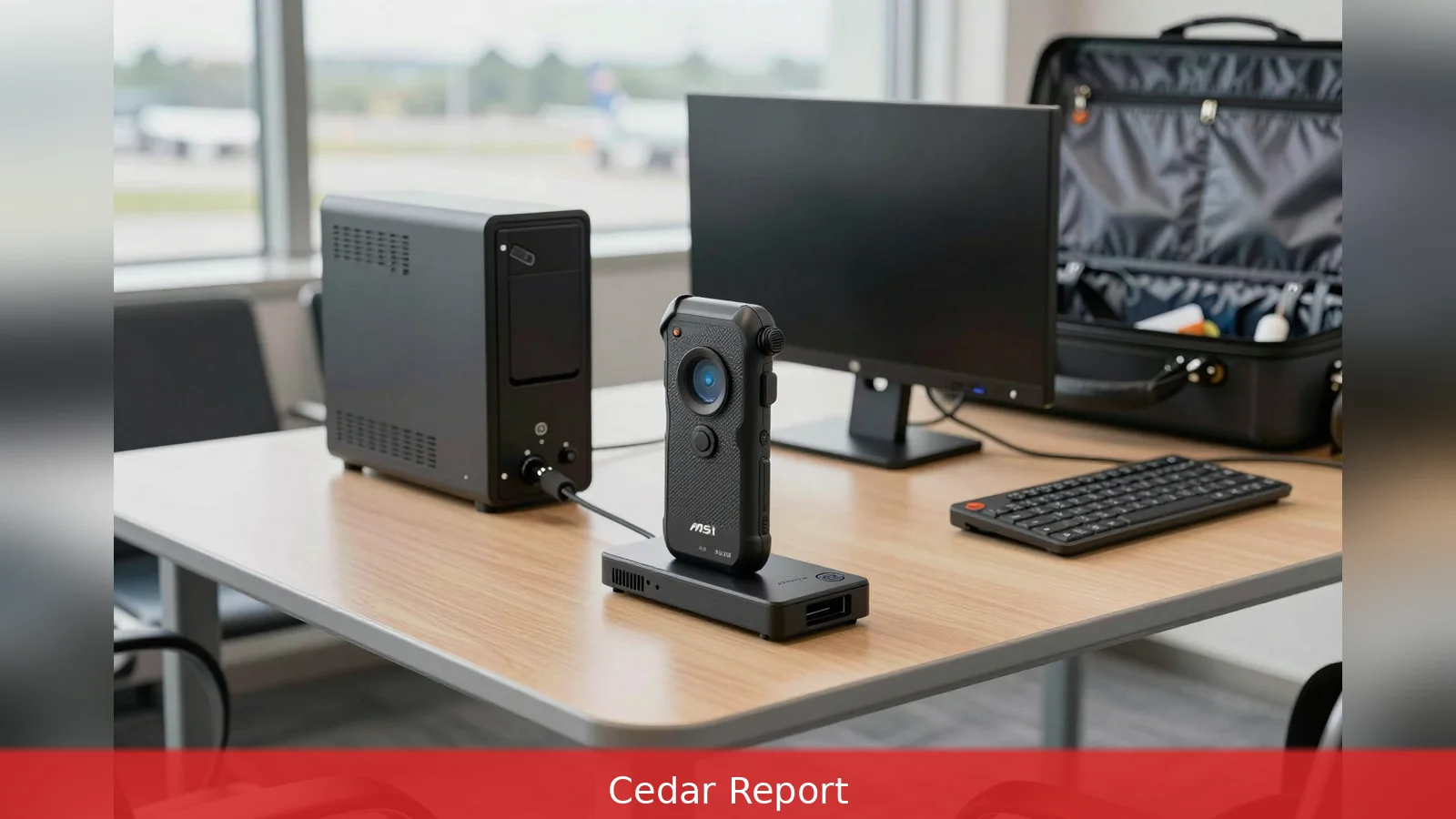
A bulky, gaming-first handheld that doubles as a compact travel workstation, the MSI Claw 8 EX AI+ surprised ZDNET's reviewer by changing role when paired with its dock. MSI calls the model a big refinement over its prior handhelds, a claim the review credits to hardware and cooling revisions plus a new Intel Arc G-Series processor. The reviewer praised sustained gaming performance, more aggressive cooling and a markedly improved physical design, while flagging buggy software and a premium price as important trade-offs. That docked flexibility matters because handheld makers are iterating fast across a field that increasingly uses Intel Arc silicon.
It looks like a thick gaming-first machine, but docked it behaves like a conventional desktop you can slip into a carry bag, ZDNET's review found.
That contrast is the central read from the review. On the surface the Claw 8 EX AI+ reads like a beefy, no-compromises handheld: flared handles, a textured grip and weight that suggests this is hardware built first for extended play. MSI reworked the ergonomics, the company says, adding flared handles and a laser-etched texture inspired by the Xbox Series X controller to make long sessions less fatiguing. The directional pad also moved to a metal-dome design MSI describes as improving input accuracy.
Performance and cooling, then polish problems
ZDNET highlighted three headline hardware strengths. First, the Claw 8 delivers strong, sustained performance in gaming workloads, a capability the reviewer links to MSI's switch to an Intel Arc G-Series processor and to a revised internal layout. Second, the cooling is more aggressive and effective than on earlier Claw models, which the reviewer says helps the system maintain higher clock rates during extended play. Third, the handheld's physical design is markedly more comfortable to hold than MSI's previous generation, reducing fatigue in longer use periods.
Those hardware gains aren't free of caveats. The reviewer flagged recurring software bugs that sometimes undermined day-to-day use and left the overall feel less polished than the hardware might suggest. The other limiter is cost: the Claw 8 EX AI+ occupies the premium end of the handheld market, making price a gating factor for many buyers.

Still, ZDNET judged the package strong enough to compare favourably against rival Windows handhelds, writing that the Claw 8 EX AI+ outperformed the Lenovo Legion Go in meaningful ways. That comparison matters because buyers balance raw performance, comfort and software polish when choosing between devices that otherwise look similar on paper.
The dock that changes how you travel
It is the dock, according to the reviewer, that turns the Claw 8 from a single-purpose gaming toy into a genuinely useful travel companion.
Pairing the handheld with its docking system, the review said, changed how the device was used away from home because the dock let the handheld act as a more conventional desktop or portable workstation during transit. The dock expands connectivity and creates a conventional desktop layout, the reviewer wrote, rather than forcing the user to rely only on the handheld's own screen and controls. For someone who travels with limited luggage, that form of optionality is the surprise: the Claw 8 packs into a bag like a gaming handheld but unpacks into a compact workstation without having to carry a separate laptop.
That repositioning is notable at a moment when the category is moving quickly. In that crowded context, MSI's approach reads as a shift from an experimental first generation toward a clearer design identity focused on sustained performance and comfortable long-form use.
Practical trade-offs remain. The reviewer praised ergonomics and cooling while warning that buggy software can erode the experience. Price and software polish are decisive variables for most shoppers because performance and comfort, however strong, are only part of the ownership equation.
MSI's own positioning of the Claw 8 EX AI+ as a meaningful refinement over earlier handhelds helps explain why the company invested in both hardware and the docking ecosystem. The reviewer treated those investments as the reason the device could credibly serve two roles: a handheld for long play sessions and a compact node for expanded connectivity while travelling.
For buyers weighing the Claw 8 against alternatives, the takeaway in the review is pragmatic. If your priority is sustained performance and you value a handheld that becomes a docked workstation, the Claw 8's hardware and cooling make a persuasive case. If you need a polished, trouble-free software experience at a lower price, the premium tag and reported bugs may point you toward rivals or toward waiting for further software refinement.
Related Articles
- 3 ways to limit Gemini in Android Auto
- LastPass data exposed via Klue breach, phishing risk rises
- Estrogen patches: demand up 162% after FDA lifts warning
ZDNET singled out the dock as the Claw 8's defining upgrade: with it the handheld becomes a compact, easy-to-pack node for expanded connectivity and a portable desktop layout. Originally reported by ZDNET.
This article was created with AI assistance.


