
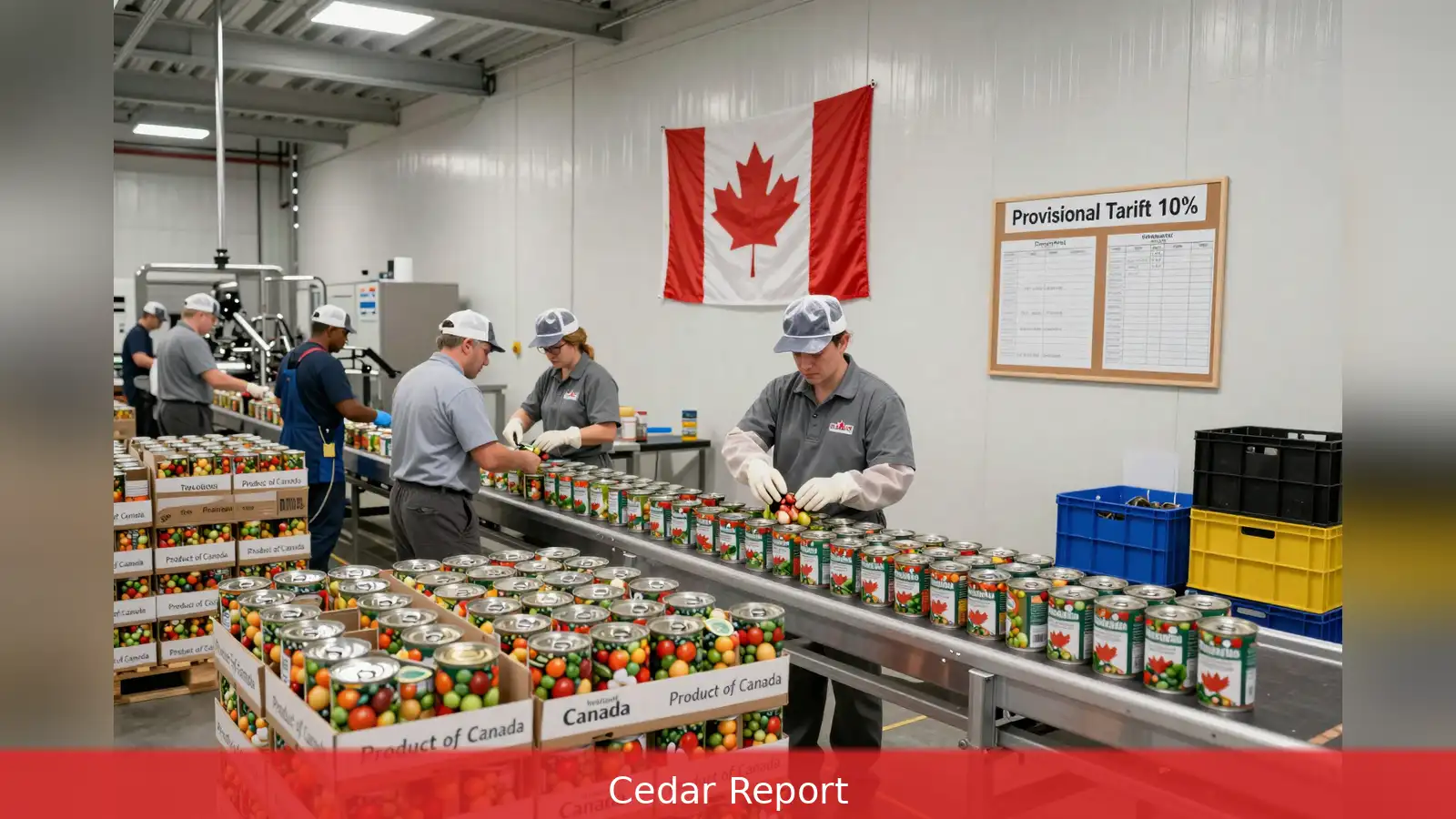
10%. Ottawa has imposed a provisional 10% surtax on canned-vegetable imports to shield domestic processors while a tribunal investigates whether imports have caused injury. The measure took effect June 19, 2026 and can remain for up to 200 days unless the Canadian International Trade Tribunal rules otherwise. The Department of Finance says the levy is temporary, with exclusions for the United States, Mexico, Israel, Chile and developing countries, and Finance Minister François-Philippe Champagne called it a balanced step to support producers without unduly raising grocery bills.
10%. The Ottawa decision uses a provisional safeguard rather than a permanent quota or long-term duty, and it ties the levy directly to the tribunal’s ongoing fact finding. The Department of Finance said the surtax will be lifted if the Canadian International Trade Tribunal concludes imports aren't harming domestic canned-vegetable processors, and that the tribunal will recommend appropriate remedies if it issues an affirmative injury finding.
The tariff is global in scope but explicitly excludes canned vegetables originating in the United States, Mexico, Israel and Chile, as well as shipments from countries designated as developing. The ministry said those carve-outs reflect Canada’s international trade obligations and are designed to limit trade diversion, where excluded suppliers might otherwise step into markets vacated by countries hit by the surtax.
Officials described the exemption list as an attempt to thread two priorities at once: provide temporary breathing room for processing and packaging operations and the growers that supply them, while keeping essential supplies flowing and prices stable for Canadian households. Finance Minister François-Philippe Champagne reiterated that line on June 19, saying the government wanted a balanced approach that supported producers without compromising affordability or food security.
The government invoked Canada’s safeguard procedures, a legal route for addressing sudden import surges that threaten domestic industries. Under those rules the provisional 10% surtax can remain in place for a maximum of 200 days unless the Canadian International Trade Tribunal’s inquiry yields a different statutory outcome. The tribunal opened its inquiry earlier this year and is tasked with determining whether the volume or price effects of increased imports have caused serious injury to domestic processors.

If the tribunal issues an affirmative injury finding it will propose remedies. In that scenario the provisional surtax could be converted into a different form of protection or extended under the administrative procedures laid out in the safeguard framework.
If the tribunal finds no injury, the Department of Finance has said the surtax will be revoked and normal trade rules will resume.
Industry exposure is concentrated in processing and packaging operations that make canned vegetables and in the growers who supply those plants. The ministry emphasised that the measure is provisional and tied to the tribunal’s fact finding rather than being a permanent policy change. Similar measures have been used in other jurisdictions in recent months as global trade patterns shifted, though Ottawa framed its action as conditional and limited in both scope and duration.
The department also highlighted food security and affordability as constraints on any remedial action. That language signals officials weighed the likely consumer-price impact of tighter import rules against the need to shield producers. The exclusions for key trading partners and developing economies are part of that calculation, intended to preserve supply lines and limit price pressure at the grocery checkout.
For processors and growers, the surtax creates an immediate margin cushion. For retailers and consumers the direct effect should be muted by the exemptions, though the government acknowledged there could be distributional effects across suppliers and regions depending on sourcing patterns and supply-chain flexibility.
Practically, the tariff is a provisional instrument that buys time while a formal administrative review proceeds. The Department of Finance emphasised the linkage: the surtax is a temporary shield while the Canadian International Trade Tribunal completes its technical review and issues a determination that will drive the next policy step.
Related Articles
- Tariff threat: USTR proposes 25% duty on Brazilian imports
- U.S. cuts some steel and aluminium tariffs to 15%
- Markets priced higher-for-longer after Warsh signals
The Canadian International Trade Tribunal must finish its inquiry by September 9, 2026. Its finding will decide whether Ottawa lifts the 10% surtax, converts it into longer-term duties or endorses tribunal-recommended remedies.
This article was created with AI assistance.


