
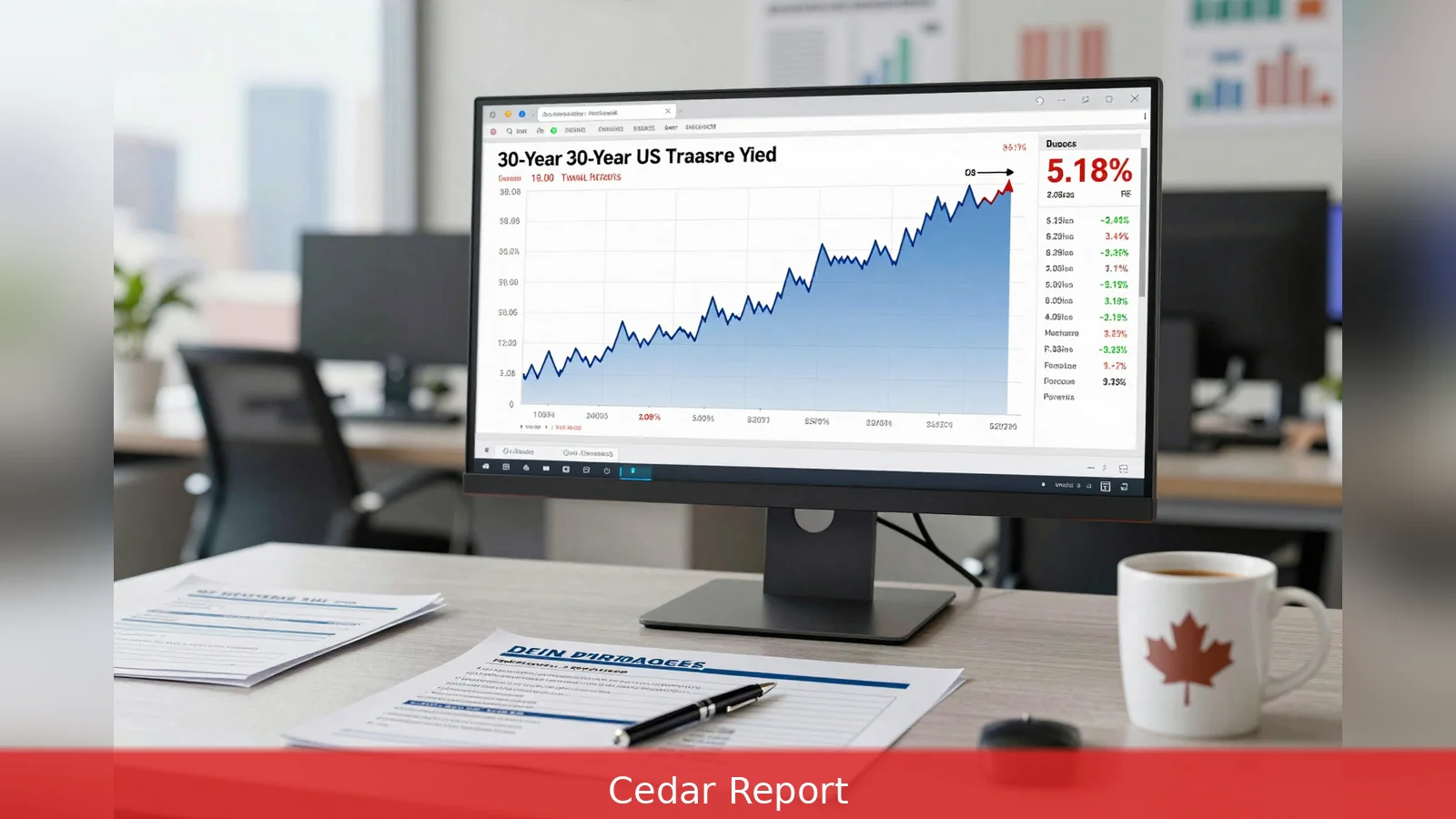
Long-term borrowing costs are back near pre-2008 levels. The 30-year US Treasury yield peaked at 5.18% earlier this year, its highest for that maturity since before the 2008 financial crisis. By mid-June it had eased to about 4.93%, but long yields remain elevated over the past 15 years in FRED data and the New York Fed's term premium model. Higher long yields raise mortgage rates, corporate borrowing costs and the government's interest bill, tightening credit for households and firms.
5.18%. That number now frames the conversation about long-duration borrowing costs in the United States and beyond. It matters because it's both a peak relative to the modern era and a measure of how much investors demand to lock in decades-long cash flows. The reading comes from the Federal Reserve's FRED daily yield series, and the New York Fed's term premium calculations show an expanded compensation for holding long-duration debt rather than rolling shorter bills.
How higher long yields translate to real costs
When the long end of the Treasury curve climbs, the effect is immediate and practical. Mortgage rates are tied to long-term yields, so a 30-year Treasury near 5.18% lifts borrowing costs for homebuyers. Corporations also pay more when they issue long-term debt, which reduces appetite for credit-sensitive investment projects. The public balance sheet is exposed as well: higher long-term yields increase the government's interest expenses, raising fiscal pressure even if the policy rate sits well below long rates.
The Federal Reserve's policy rate, left at a 3.50% to 3.75% range at its June 16-17 meeting, sits noticeably below the long end of the curve. That gap creates a steeper yield structure, and that steepness isn't merely academic. It transmits higher long-term funding costs into mortgages and corporate credit despite a policy rate that's materially lower than long-term yields.
Monetary policy developments this month helped move both short and long yields. At its first meeting under Chair Kevin Warsh, the Federal Reserve left the target range unchanged but signalled a higher-for-longer stance through a shorter statement and the committee's projections. Markets reacted by repricing the odds of further tightening later in 2026. Short-dated Treasury yields climbed and two-year notes briefly traded near the mid-4% area as investors increased bets on a possible September move. Those repricings raised hedging costs and exacerbated mark-to-market losses for holders of long-duration bond funds, highlighting the trade-off investors face: higher current yields for new buyers versus price volatility for existing holders.

Where this sits in historical perspective
The raw data sketch a clear multi-decade pattern. Daily yields for several maturities from FRED show that yields collapsed after the 2008 crisis and fell again during the COVID shock, then rose sharply in the most recent cycle. The 5.18% peak this year compares with a 2007 high of 5.35%, so the current peak is elevated but not without precedent.
On a distributional basis, the 30-year sits at the 78.8th percentile of all daily values since 2000, which signals levels high relative to the past 25 years but short of the absolute historical extreme.
The shape of the curve this year also differs from earlier episodes. In 2026 a normal upward-sloping curve is in place, with short-term market rates roughly in the 3.7% to 4.0% area and long-term yields clustered in the 4.5% to 4.9% range when measured by FRED and the New York Fed term premium. That contrasts with 2007, when short-end inversion occurred because the policy rate exceeded some long yields, and with 2019, when the curve was unusually flat, term premium was low and inflation expectations were muted.
For borrowers and policymakers the difference matters. A steep curve with an expanded term premium signals investor caution about locking in long durations, and it raises the cost of funding for long-term projects. It also makes balance-sheet management trickier for institutions that hedge duration and for pension funds that target long liabilities.
Markets will continue to price in both policy expectations and the compensation investors demand for duration risk. The interaction between the Federal Reserve's policy path and the term premium component of long yields will determine whether elevated long-term rates become a sustained feature of the financial landscape or settle back toward lower bands seen in the prior decade.
Related Articles
- Markets priced higher-for-longer after Warsh signals
- 3.5%-3.75% and Warsh: Fed clash or truce
- How to file crypto taxes in India: 30% rate, 1% TDS
Markets are already pricing a potential September rate hike. That decision will shape short-term yields and the term premium that is keeping long-term rates near two-decade highs.
This article was created with AI assistance.


